How to Cook Lentils: Red, Green and Brown
Red, green and brown lentils cook differently, so here are the ratios, times and tips for each, with notes where sources disagree.
- Rinse and sort lentils, but soaking is optional [2][3].
- Brown and green hold their shape and are interchangeable; red breaks down for soups and dals [1][6].
- Liquid ranges from 1 ½ to 3 cups per cup of lentils depending on type and source, so check the packet [1][2][5].
- Avoid acidic ingredients in the cooking water and add lemon juice or vinegar at the end [2][5].
- Store cooked lentils covered in the fridge for 3 to 5 days, or up to one week per another source [1][5].
Know your lentils before you cook
Lentils are pulses that cook faster than dry beans and do not need pre-soaking [1]. Brown lentils are the most common variety in grocery stores [6]. They range in color from khaki-brown to dark black and generally have a mild, earthy flavor [6]. They also hold their shape well after cooking [6].
Green lentils can be pale or mottled green-brown with a glossy exterior [6]. They have a robust, somewhat peppery flavor [6]. They keep a firm texture after cooking, which makes them ideal for salads and side dishes [6]. Brown and green lentils can be used interchangeably in recipes because they have similar cooking times [1].
Red lentils range in color from gold to orange to red, and they are the sweetest and nuttiest of the lentils [6]. Red and yellow lentils are often sold split, so they cook faster and break down more easily [1]. Red split lentils cook into a rich puree, which makes them good for thickening soups and casseroles [2].
Two specialty types are worth knowing. Puy lentils are grey-green, grown in Le Puy, France, and often cost more than other common varieties [2]. Beluga lentils are the blackest and tiniest lentils and have a rich, deeply earthy flavor [6].
Rinse, sort and decide about soaking
Before cooking, rinse lentils in cold water, pick over them to remove debris or shrivelled lentils, then drain [2].
Lentils need no soaking, unlike many other legumes [3][4][5]. Soaking is optional, and an overnight soak can reduce cooking time by about half [1][2]. If you do soak, keep the lentils covered in the refrigerator rather than on the counter.
The basic stovetop method
This guide focuses on the stovetop method. Put the rinsed lentils in a pot, add water, bring to a boil, then reduce the heat to a simmer [3]. One source adds cold or lukewarm water to the lentils [3].
The sources give different amounts of liquid, so treat the numbers as a range. One source calls for 2 ½ cups of liquid per cup of brown or green lentils and 1 ½ cups per cup of red or yellow lentils [1]. Another says to boil lentils in three times their volume of water [2]. A third uses 3 cups of water for 1 cup of lentils [5]. A fourth uses 5 cups of water for 1 pound (2 1/3 cups) of lentils [3].
Cooking times differ between sources too. Lentils vary in cooking time depending on variety and age, so always check the packet [2]. Start tasting at the shortest time listed and keep going until they are tender.
One pound of dry lentils cooked this way makes 6 2/3 cups of cooked lentils with about 1 cup of liquid [3]. If you plan to drain the lentils, save the cooking liquid to use in soups, gravies or stews [3].
- Pressure cooker: one source says to pressure-cook lentils for around 20 to 30 minutes depending on type [2]. Another says a pressure cooker is not advisable because the cooking period is so short [3]. If you try it, watch the time closely.
Liquid and time at a glance
The table lists each source's figures side by side. The sources do not always agree, so use the ranges as a starting point and check the packet [2]. Source [1] groups red and yellow lentils together at 15 minutes, while source [2] lists yellow lentils separately at 40 to 45 minutes and red split lentils at 15 to 20 minutes. If your yellow lentils are not tender at 15 minutes, keep simmering and follow the packet [1][2]. Source [2] and source [5] both use 3 cups of water per cup of lentils, and source [5] gives that amount without limiting it to one variety [2][5].
Season the pot for better flavor
Lentils take on whatever flavors you add to the pot, much like rice [1]. Cooking them in broth or stock instead of plain water adds flavor [1]. Use broth or stock if you have it [5]. If you use a bouillon cube or powder, dissolve it in water first [5].
Fresh or powdered onion or garlic boosts flavor [5]. Salt, pepper, chili powder, cumin, curry powder, oregano and thyme are all suggested seasonings [5]. For brown lentils, garlic, spices, herbs or a sprinkle of salt bring out their best flavor [1].
Avoid cooking lentils with anything acidic, such as vinegar [2]. A different source suggests finishing cooked lentils with a small splash of oil, butter, lemon juice or vinegar [5]. Together, these point to adding acid at the end rather than in the cooking water. For dry beans in general, one source advises adding salt when they are almost tender, because adding it too early can toughen them [4].
Cooking lentils in soups and other dishes
For a basic lentil soup, use 1 cup of lentils and 4 cups of water or broth [5]. Simmer for about 20 to 25 minutes until the lentils are soft [5].
If you are adding lentils to a soup or stew that is already simmering, timing depends on the type. Add brown or green lentils 45 minutes before the soup is done [1]. Add red or yellow lentils about 15 minutes before it is done [1].
Match the lentil to the job. Red lentils get mushy when cooked through, so they suit Indian dals, other curries and thickened soups [6]. Green and brown lentils tend to keep their shape, so they work in warm salads, casseroles and stuffing [2].
For a thick, soft result, pick red split lentils and let them break down [1][2]. For distinct, separate lentils, pick green or brown and avoid overcooking [2][6].
Storing dry and cooked lentils
Keep dry lentils in an airtight container in a cool, dry place [2]. They can be kept and eaten indefinitely, but they are best enjoyed within one year of purchase [2]. Another source says dry lentils stay good for 1 to 2 years if kept dry and sealed [5].
Cooked lentils can be stored in a covered container in the fridge for 3 to 5 days [5]. Another source says they can be prepared ahead and refrigerated for up to one week [1]. When the sources differ, the shorter window is the more cautious choice.
Frequently asked questions
Do I have to soak lentils?
No. Lentils do not need soaking the way other legumes do [3][4][5]. An overnight soak can cut cooking time by about half [1][2]. If you soak, keep them covered in the refrigerator.
Can I swap brown and green lentils?
Yes. Brown and green lentils can be used interchangeably in recipes because they have similar cooking times [1].
Why did my red lentils turn mushy?
Red lentils tend to get mushy when cooked through [6]. Red and yellow lentils are often sold split, so they cook faster and break down more easily [1].
Why does my yellow lentil time not match the red?
One source groups red and yellow lentils together at 15 minutes [1]. Another lists yellow lentils separately at 40 to 45 minutes [2]. Cooking times vary by variety and age, so check the packet [2].
Sources
- What Do I Do With Lentils? (wicworks.fns.usda.gov)
- Lentils (bbcgoodfood.com)
- Cooking With Lentils (ir.library.oregonstate.edu)
- Vegetables and Fruits for Health: Preparing Dry Beans, Peas, and Lentils (extension.umaine.edu)
- Cooking Lentils: A Simple Guide (ncdhd.ne.gov)
- What’s the Difference Between Brown, Green, and Red Lentils? - What’s the Difference Between Brown, Green, and Red Lenti (thekitchn.com)
Recipes that use this
 AI-generated image
Red Lentil Soup (Turkish Mercimek Çorbası)
A silky, gently spiced red lentil soup made from pantry staples, finished with lemon and a sizzling mint and chili oil.
 AI-generated image
Lentil Kofte (Mercimek Köftesi)
Soft red lentils and fine bulgur are kneaded with a sweet-spicy onion and pepper paste base, divided into 24 equal pieces, shaped by hand and served cool with lettuce and lemon.
 AI-generated image
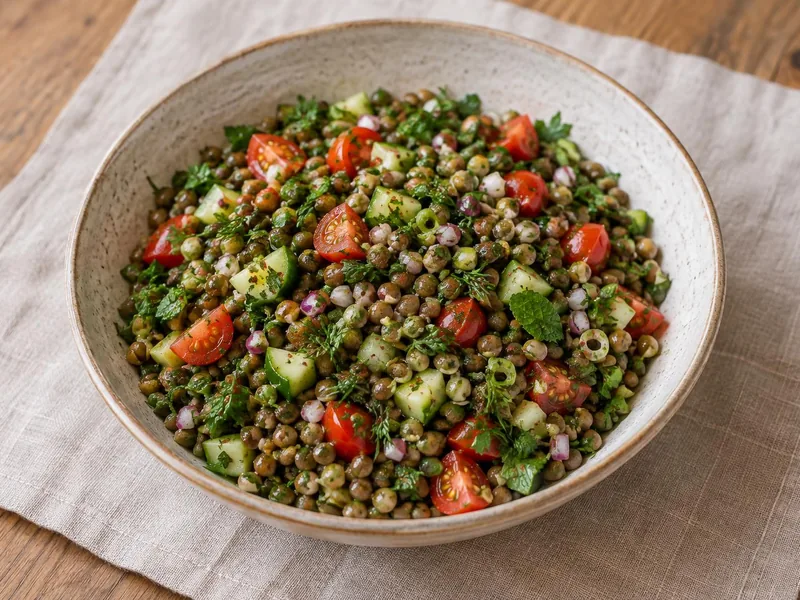
Lentil Salad with Herbs and Lemon
Tender, intact lentils soak up a bright lemon and olive oil dressing while fresh herbs and crisp vegetables keep every bite lively.