Shakshuka
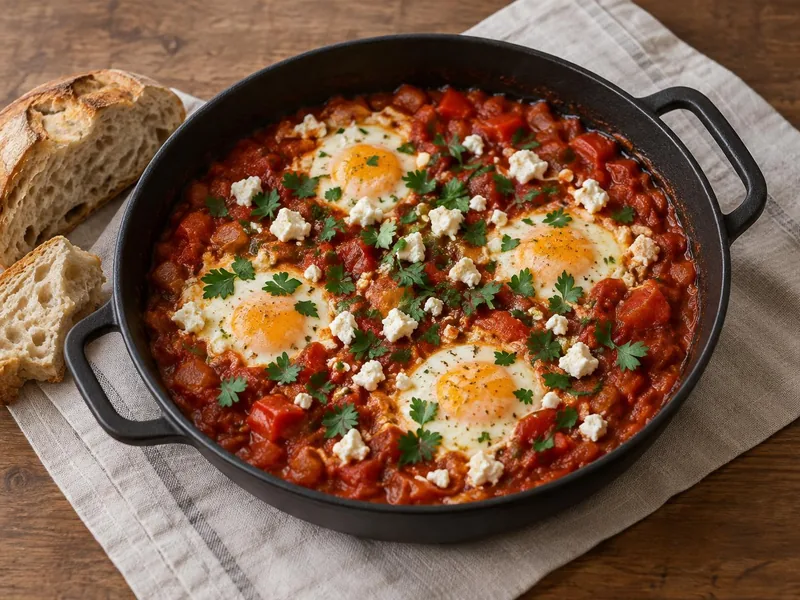
Eggs gently cooked in a thick, cumin and paprika scented tomato and pepper sauce, made in one pan and served with bread for scooping.
 AI-generated image
- 800 gtomatoes
- 400 geggs
- 200 gyellow onion
- 200 gred bell pepper
- 120 gcrusty bread or pita
Shakshuka is a dish of eggs cooked directly in a spiced tomato and pepper sauce. Versions of it are eaten across North Africa, the Levant and Turkey, often for breakfast or a relaxed brunch, and also as a light supper. The pan goes straight to the table, with bread for scooping.
What makes this version work is the sauce. Onion and red pepper are cooked until properly soft before any tomato goes in, tomato paste and spices are fried briefly in the oil to deepen them, and the canned tomatoes are simmered until thick enough to hold a well for each egg. A watery sauce floods the eggs and cooks them unevenly, so the doneness cues below matter more than the clock. The eggs are cooked until the whites and yolks are fully set, to 71 C (160 F) in the center. A softer, runny-yolk option for pasteurized eggs is in the notes.
Feta and parsley go on at the end for salt and freshness. The dish is vegetarian when you buy feta made with microbial or vegetable rennet, so check the label. The sauce can be made a few days ahead, so the eggs take only about 15 minutes on the day.
Preparation
- Step 013 min
Crush the canned tomatoes with your hands in a bowl until no large pieces remain. Set aside with all their juice. Dice the onion and pepper and slice the garlic.
- Step 023 min
Heat the olive oil in the skillet over medium heat for about 3 minutes, to around 160 C (320 F), until it shimmers.
- Step 038 min
Add the onion and a pinch of the salt. Cook, stirring often, until soft, translucent and just starting to turn golden at the edges.
- Step 047 min
Add the diced red pepper and cook, stirring, until it has softened and the pieces collapse slightly when pressed with the spoon.
- Step 052 min
Stir in the garlic, tomato paste, cumin, paprika and Aleppo pepper. Cook, stirring constantly, until the paste darkens to brick red and the spices smell fragrant. Do not let the garlic brown.
- Step 061 min
Pour in the crushed tomatoes and the water. Add the remaining salt, black pepper and the sugar if using. Stir, scraping up any browned bits from the pan.
- Step 0718 min
Bring to a gentle simmer over medium-low heat and cook uncovered, stirring now and then, until thick and jammy. A spoon dragged across the bottom of the pan should leave a clear trail that closes slowly. Taste and add more salt if needed.
- Step 081 min
Reduce the heat to low. Use the back of a spoon to make 8 shallow wells in the sauce, spaced evenly. The sauce should be bubbling gently at the edges.
- Step 092 min
Crack each egg into a small cup first, then slip it into a well. This lets you remove any shell and keeps the yolks intact. Season the eggs lightly with salt and pepper.
- Step 1012 min
Cover the pan and cook on low heat until the whites are completely opaque and firm and the yolks are no longer liquid and do not wobble when the pan is nudged, about 10 to 12 minutes. If the whites are slow to set, spoon a little hot sauce over them.
- Step 11
Check that the eggs are done: an instant-read thermometer in the center of a yolk should read at least 71 C (160 F). If not, cover and cook 1 to 2 minutes more and check again.
- Step 12
Remove from the heat. Scatter the feta and parsley over the top and serve from the pan with warm bread.
Kitchen notes
- Make ahead: the sauce through step 7 can be made ahead. Divide it into shallow containers, refrigerate within 2 hours, keep at 4 C (40 F) or below and use within 3 days. Reheat in the skillet until bubbling and at least 74 C (165 F) in the center, then add the eggs as written.
- Storage: leftover shakshuka with cooked eggs is best eaten the same day. Refrigerate within 2 hours at 4 C (40 F) or below, eat within 1 day, and reheat until at least 74 C (165 F) in the center.
- Oven finish: after step 9, cover the oven-safe skillet with its lid or foil and transfer to an oven at 190 C (375 F) for 12 to 15 minutes, until the whites are opaque and firm, the yolks are set and the center of a yolk reads at least 71 C (160 F).
- Softer yolks: only if you use pasteurized in-shell eggs, cook step 10 for about 6 to 8 minutes, until the whites are opaque and set and the yolks still wobble. Do not serve runny yolks made with ordinary eggs to pregnant women, older adults, young children or anyone with a weakened immune system.
- Variations: add 150 g of baby spinach to the sauce at the end of step 7 and stir until wilted, or stir in a drained 240 g can of chickpeas for a heartier dish. Replace the feta with dollops of thick yogurt for a milder finish.
- Cooking for fewer people: halve the sauce and use a smaller pan, making 4 wells for 2 servings.
Diet and allergens
Suitable for: Vegetarian, Nut-free.
Contains: milk, egg, gluten.
Labels come from the ingredient list by fixed rules. If you cook for someone with an allergy, check the labels of packaged ingredients such as stock, spice blends, tahini and bread, since brands differ. How labels work.
Frequently asked questions
Why is my shakshuka watery?
The sauce was not reduced enough before the eggs went in. Simmer it uncovered until a spoon leaves a trail on the pan bottom, and keep the lid on only once the eggs are in.
Can I use fresh tomatoes instead of canned?
Yes, use about 1 kg of ripe tomatoes, chopped, and simmer a little longer, 5 to 10 minutes, until the sauce is thick. Canned tomatoes are more consistent when fresh ones are not in season.
How do I know the eggs are done?
The whites should be completely opaque and firm, and the yolks set rather than liquid. An instant-read thermometer in the center of a yolk should read at least 71 C (160 F).
Can I make shakshuka with runny yolks?
Only with pasteurized in-shell eggs, cooked about 6 to 8 minutes until the whites are set. Anyone pregnant, elderly, very young or with a weakened immune system should be served fully cooked eggs.
Is shakshuka vegetarian?
Yes, as long as the feta is made with microbial or vegetable rennet, since some feta uses animal rennet. Check the label or leave the feta out.
Is shakshuka spicy?
This version is mildly warm. Reduce the Aleppo pepper for less heat, or add another 1 to 2 g, or a sliced fresh chili with the onion, for more.
References and sources
- Nutrition: USDA FoodData Central records extra virgin olive oil (FDC 171413), yellow onion (FDC 790646), red bell pepper (FDC 170108), garlic (FDC 169230), tomato paste (FDC 170459), ground cumin (FDC 170923), sweet paprika (FDC 171329), Aleppo pepper or red pepper flakes (FDC 170932), canned whole peeled tomatoes with juice (FDC 170051), water (FDC 173647), granulated sugar (FDC 169655), fine salt (FDC 173468), freshly ground black pepper (FDC 170931), eggs (FDC 171287), feta cheese (FDC 173420), fresh flat-leaf parsley (FDC 170416), crusty bread or pita (FDC 325871).
- Proportions: main ingredients and salt per serving were compared with the median of 2 published recipes for this dish. How we make recipes.
 AI-generated image
Menemen
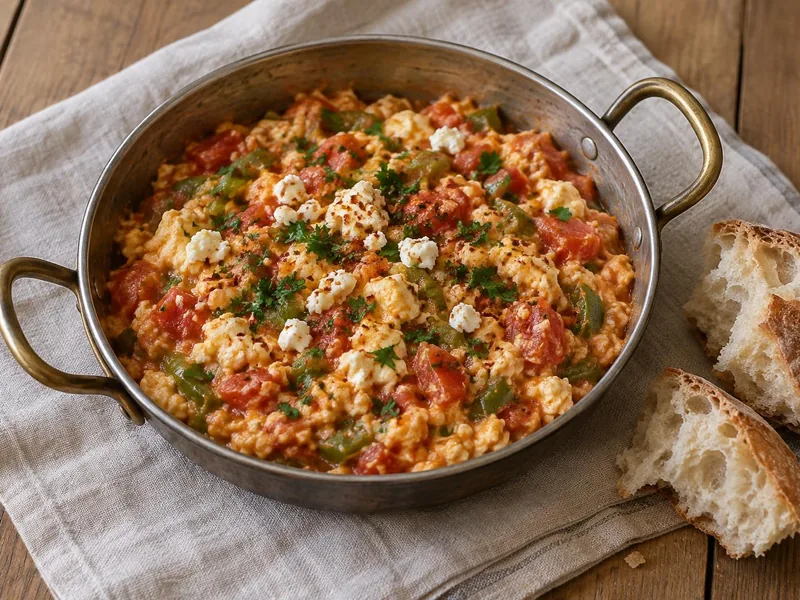
Turkish scrambled eggs set softly in a jammy sauce of tomatoes and green peppers, made in one pan and scooped up with bread.
 AI-generated image
Muhammara
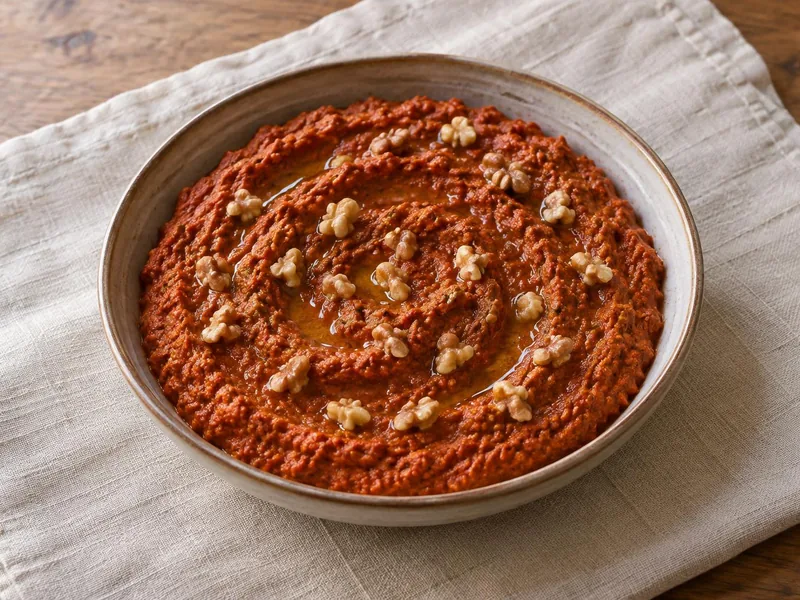
A smoky red pepper and walnut dip with a sweet-sour edge from pomegranate molasses, best scooped up with warm bread.
 AI-generated image
Ezme (Turkish Spicy Tomato and Pepper Salad)
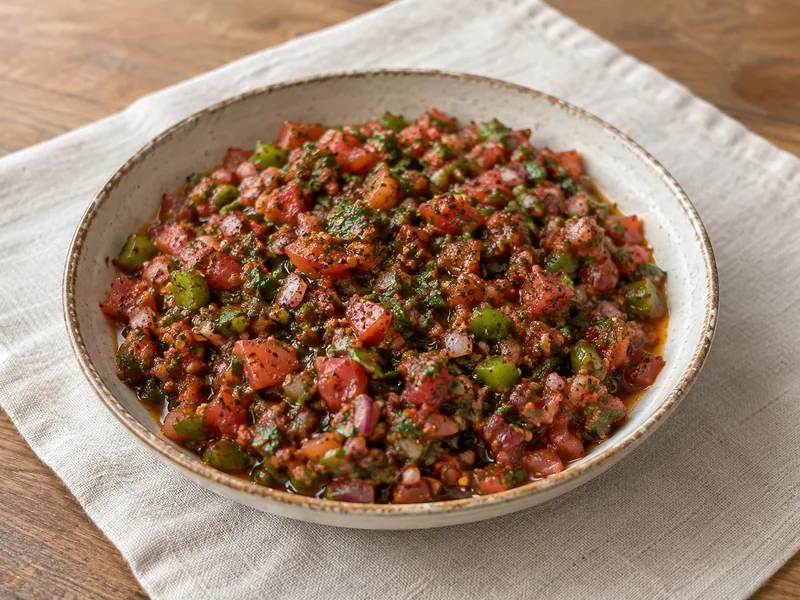
A finely chopped, tangy and gently fiery tomato and pepper salad that works as a meze, a spoonable relish or a topping for grilled food.