Baked Falafel
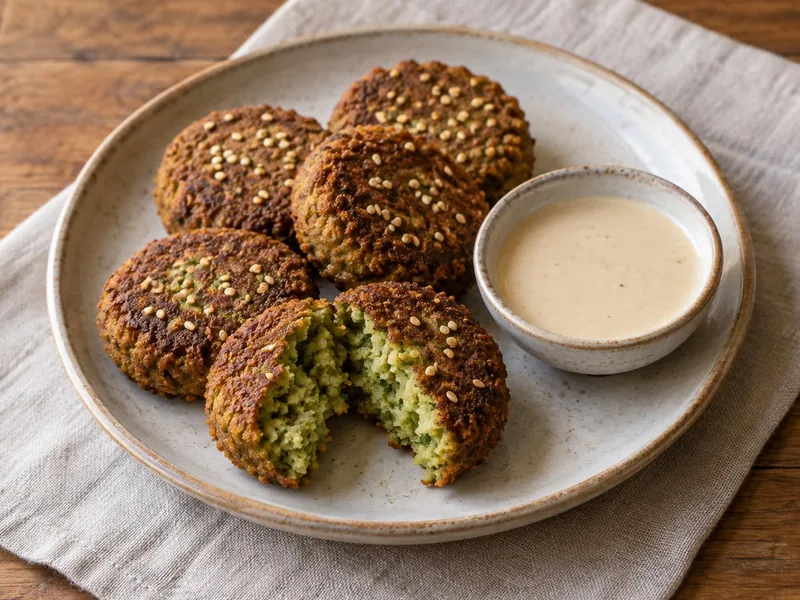
Soaked raw chickpeas, plenty of fresh herbs and a hot, oiled tray give falafel patties a crisp golden crust and a tender green middle, with no frying.
 AI-generated image
- 250 gdried chickpeas
- 100 gyellow onion
- 90 gtahini
- 45 gflat-leaf parsley
- 45 glemon juice
Falafel are patties or balls of ground chickpeas, herbs, onion and spices, eaten across the Middle East and well beyond, usually tucked into pita with salad and tahini sauce. They are traditionally deep-fried. This version bakes them as patties on an oiled tray in a hot oven, so there is no pot of hot oil to manage.
The method follows classic falafel. The dried chickpeas are soaked but not cooked, then pulsed with the herbs to a coarse crumb; canned or cooked chickpeas are too soft and wet and give a pasty result. A little chickpea flour helps the patties hold together, and shaping them flat lets them crisp on both sides and cook through evenly.
Plan ahead: the chickpeas soak for 12 to 18 hours in the refrigerator, and that time is not included in the times above. After soaking, expect about 1 hour 30 minutes to the table, including 30 minutes for the mixture to chill while the oven heats and you make the tahini sauce.
Preparation
- Step 01
The day before, rinse the dried chickpeas and put them in the large bowl or container with the 1000 g cold water. Cover and refrigerate at 4 C (40 F) or below for 12 to 18 hours. Do not soak them at room temperature. They are ready when they have roughly doubled in size and a chickpea snaps cleanly in half, evenly pale and moist inside with no hard core.
- Step 025 min
Drain the chickpeas in the colander, rinse them well under cold water and drain again. Spread them on the clean kitchen towel and pat them dry. Wet chickpeas make a soft mixture that will not hold its shape.
- Step 033 min
Put the parsley, cilantro, onion and the 4 garlic cloves in the food processor and pulse until finely chopped, scraping down the sides once. Stop before it turns into a wet puree.
- Step 045 min
Add the drained chickpeas, cumin, coriander, cayenne, the 5 g salt, the chickpea flour and the 30 g olive oil for the mixture. Pulse in short bursts, scraping down the bowl a few times, until the mixture looks like coarse sand and holds together when you squeeze a little in your hand. It should not be a smooth paste.
- Step 0530 min
Scrape the mixture into a bowl, cover and refrigerate for 30 minutes. This firms it up and makes shaping easier.
- Step 06
Meanwhile, heat the oven to 200 C (400 F) with a rack in the center. Line the baking sheet with baking paper and brush the paper evenly with 20 g of the olive oil for the tray (about 1 1/2 tablespoons).
- Step 074 min
Make the tahini sauce. In the small bowl, whisk the tahini, lemon juice, grated garlic and the 1 g salt; it will thicken and stiffen at first. Whisk in the cold water a little at a time until the sauce is smooth, pale and pourable, like thick cream. Taste and adjust, then cover and refrigerate until serving.
- Step 0810 min
Sprinkle the baking soda over the chilled mixture and mix it in well. Take about 40 g of the mixture (2 heaped tablespoons), squeeze it firmly into a ball, then flatten it into a patty about 5.5 cm (2 1/4 in) across and 1.5 cm (5/8 in) thick. Set it on the oiled paper and repeat, leaving about 2 cm (3/4 in) between patties. You should get about 20.
- Step 092 min
Brush the tops of the patties with the remaining 10 g olive oil and sprinkle with the sesame seeds, if using.
- Step 1030 min
Bake for 15 minutes, until the undersides are golden brown. Turn each patty over with the thin metal spatula and bake for 10 to 15 minutes more, until both sides are deep golden and crisp and the patties feel firm when pressed.
- Step 11
Break one patty open to check: the inside should be steaming hot, moist and green, with no wet or pasty raw center. If it still looks wet in the middle, bake the batch for 5 minutes more.
- Step 12
Serve hot with the tahini sauce, either in warm pita or flatbread with salad (use gluten-free bread if you need a gluten-free meal) or on a plate with salad and pickles.
- Step 13
Refrigerate leftover falafel and tahini sauce in covered containers within 2 hours of baking, or within 1 hour if the room is above 32 C (90 F).
Kitchen notes
- Time: the times above do not include the 12 to 18 hours of soaking in the refrigerator, so start the day before.
- Never use canned or cooked chickpeas for falafel. They are already soft and wet, so the mixture turns pasty and the patties fall apart or stay mushy inside.
- Binding: if the chilled mixture will not hold together when squeezed, pulse in up to 10 g more chickpea flour. All-purpose (plain) flour works the same way, but then the falafel contain wheat gluten.
- Oven temperatures are for a conventional oven. For a fan (convection) oven, set it 20 C (about 25 F) lower and check a few minutes early.
- Baked falafel are a little drier and less crunchy than deep-fried ones. Oiling the paper, brushing the tops and turning the patties halfway give the crispest crust.
- Make ahead: the uncooked mixture keeps, covered in the refrigerator, for up to 24 hours; add the baking soda only just before shaping. Shaped, uncooked patties can be frozen on a lined tray, then packed into a freezer bag for up to 3 months. Bake them from frozen, adding 5 to 8 minutes, and check that the centers are hot and cooked through.
- Storage: keep cooked falafel covered in the refrigerator at 4 C (40 F) or below for up to 3 days, and the tahini sauce for up to 4 days. Reheat the falafel on a baking sheet at 200 C (400 F) for 8 to 10 minutes, until hot throughout and crisp again. The sauce thickens when cold; whisk in a little water before serving.
Diet and allergens
Suitable for: Vegan, Vegetarian, Gluten-free, Dairy-free, Nut-free.
Contains: sesame.
Labels come from the ingredient list by fixed rules. If you cook for someone with an allergy, check the labels of packaged ingredients such as stock, spice blends, tahini and bread, since brands differ. How labels work.
Frequently asked questions
Can I use canned chickpeas for baked falafel?
No. Canned chickpeas are cooked and wet, so the mixture becomes a soft paste and the patties will not hold their shape or crisp. Soak dried chickpeas in the refrigerator overnight instead.
Why do my baked falafel fall apart?
The chickpeas or herbs were probably too wet, or the mixture was not pulsed enough to bind. Dry them well, pulse until a squeezed handful holds together, chill the mixture for 30 minutes and add a little more chickpea flour if needed.
Why are my baked falafel dry?
They may have baked too long or been shaped too thin. Keep the patties about 1.5 cm (5/8 in) thick, oil the paper and the tops, and take them out as soon as both sides are deep golden.
Why soak the chickpeas in the refrigerator?
Soaking for 12 to 18 hours at room temperature lets bacteria multiply, especially in a warm kitchen. Soaking covered in the refrigerator hydrates the chickpeas just as well.
Are baked falafel as crispy as fried falafel?
They get a crisp, golden crust, especially when the tray is oiled and the patties are turned halfway, but they are not as crunchy as deep-fried falafel.
References and sources
- Nutrition: USDA FoodData Central records Dried chickpeas (FDC 173756), Cold water, for soaking (FDC 173647), Flat-leaf parsley (FDC 170416), Cilantro (fresh coriander) (FDC 169997), Yellow onion (FDC 170000), Garlic (FDC 1104647), Ground cumin (FDC 170923), Ground coriander (FDC 170922), Cayenne pepper (FDC 170932), Fine salt (FDC 173468), Chickpea flour (gram flour) (FDC 174288), Baking soda (bicarbonate of soda) (FDC 175040), Olive oil (FDC 171413), Olive oil (FDC 171413), Sesame seeds (FDC 170150), Tahini (FDC 170189), Lemon juice (FDC 167747), Cold water (FDC 173647), Garlic (FDC 1104647), Fine salt (FDC 173468).
- Proportions: main ingredients and salt per serving were compared with the median of 4 published recipes for this dish. How we make recipes.
 AI-generated image
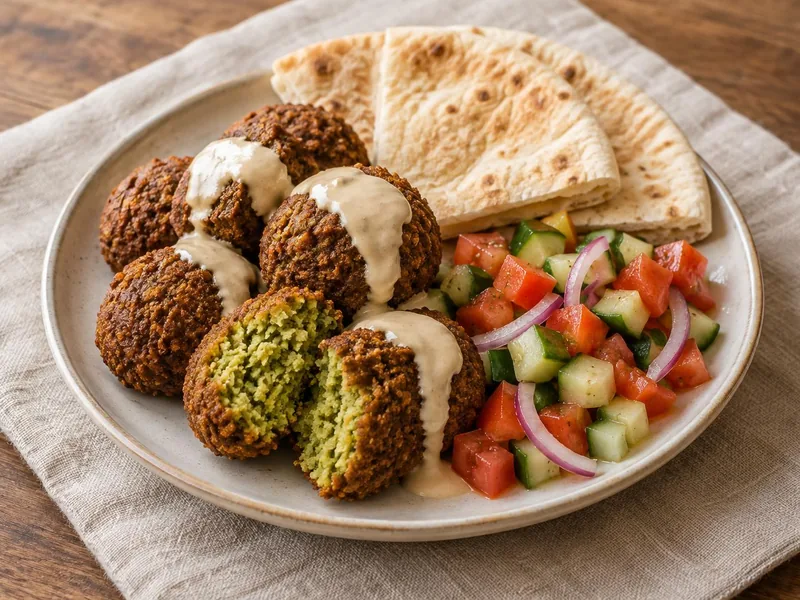
Falafel
Soaked raw chickpeas and a lot of fresh herbs give falafel a shatter-crisp crust and a tender, green, fluffy middle.
 AI-generated image
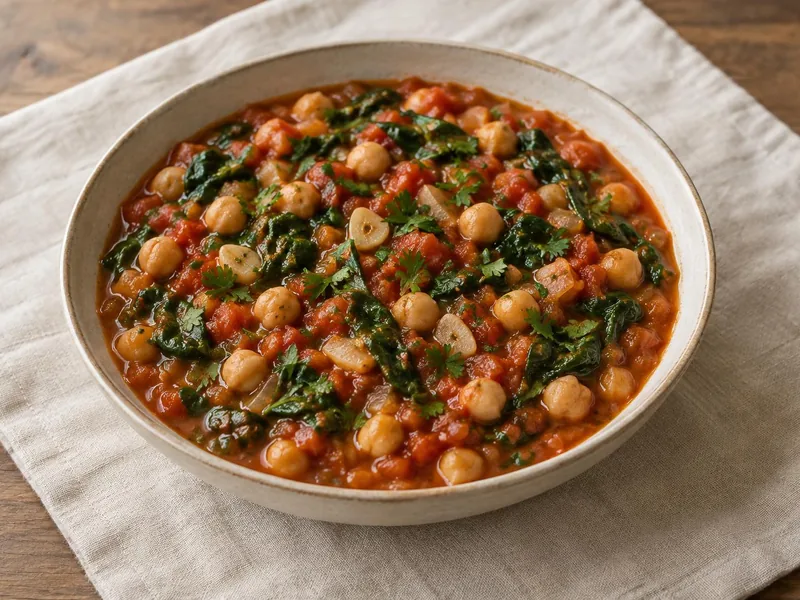
Chickpea Stew with Tomatoes and Spinach
Home-cooked chickpeas simmer in a tomato and pepper-flake sauce, then wilted spinach and lemon brighten the pot at the end.
 AI-generated image
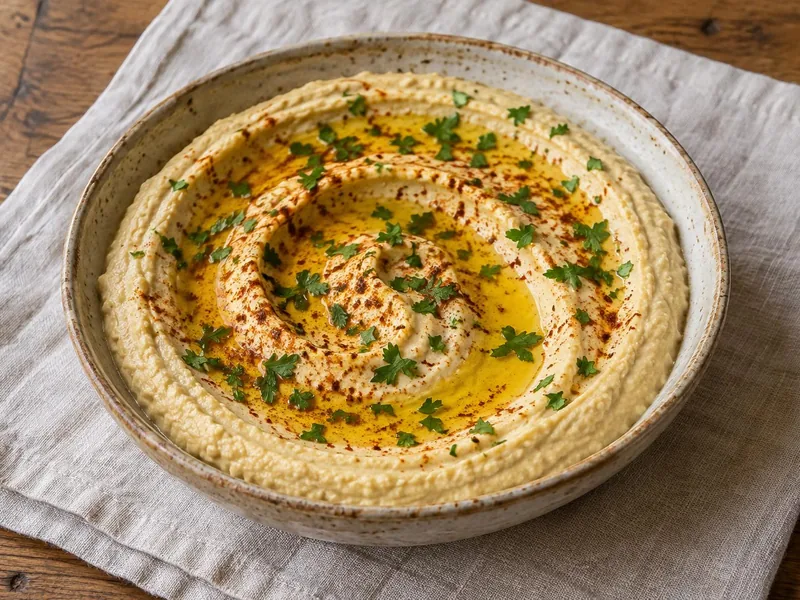
Hummus
Soft-cooked chickpeas, a tahini and lemon base whipped with ice water, and a few minutes in the food processor give a silky, spoonable hummus.