Za'atar Flatbread (Manakish)
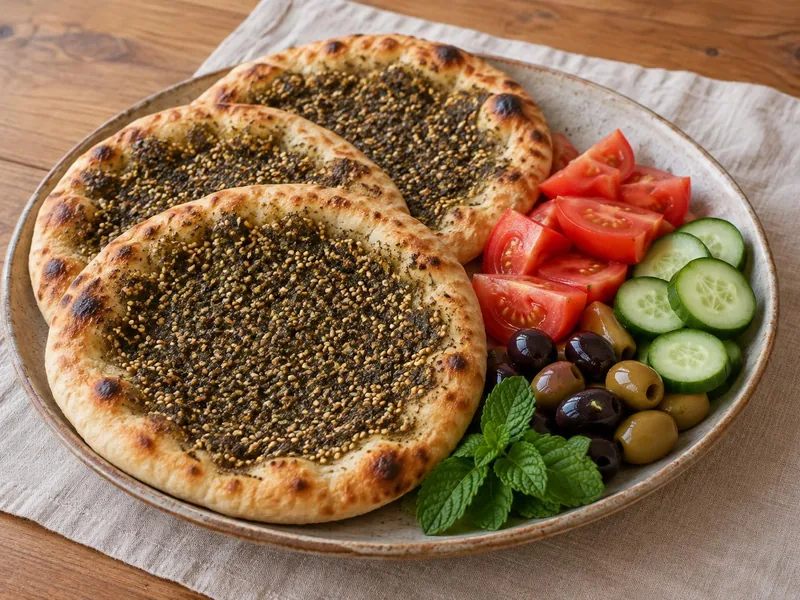
Soft, chewy flatbreads brushed with a thyme, sesame and sumac za'atar paste and baked hot until the edges blister and brown.
 AI-generated image
- 400 gbread flour
- 240 gripe tomatoes
- 200 gcucumber
- 60 golive oil
- 60 gpitted olives
Manakish (also spelled man'oushe) is a flatbread topped with za'atar, a Levantine blend of dried thyme or similar herbs, sesame seeds, sumac and salt, stirred into olive oil. It is commonly eaten at breakfast or as a snack across the Levant and beyond, often with fresh vegetables, olives and mint on the side.
This version uses a simple yeasted dough with a little olive oil, which keeps the bread soft and easy to fold. The dough is rested before shaping so it stretches without springing back, and it is dimpled with your fingertips so the za'atar oil pools in small wells instead of sliding off. The dough is lightly salted, and the za'atar is mixed from its parts so you control the salt in the topping.
A very hot baking surface is the key. Each flatbread cooks in under 10 minutes, so the edges blister and brown while the center stays tender. The oven is started while the dough finishes its first rise, so everything is ready at the same moment. Each bread is timed from the moment it goes into the oven, so none dries out while another finishes. Serve the breads warm, torn or folded, with the tomato, cucumber, mint and olive plate.
Preparation
- Step 013 min
In a large bowl, stir together the bread flour, instant yeast, sugar and the 5 g fine salt for the dough. Add the lukewarm water and the 30 g olive oil, and mix until no dry flour remains and you have a shaggy dough.
- Step 0210 min
Turn the dough onto a lightly floured surface and knead for 8 to 10 minutes, until smooth and elastic. It should spring back slowly when you press a fingertip into it and feel soft but not sticky. Add a teaspoon of flour at a time only if it sticks badly to your hands.
- Step 0330 min
Rub the 5 g olive oil around a clean bowl, add the dough, and turn it once to coat. Cover with a damp towel or plastic wrap and leave in a warm spot. The full first rise takes 60 to 75 minutes; the next step starts after the first 30 minutes of it.
- Step 0435 min
With the dough still rising, set a baking stone, or two heavy baking sheets turned upside down, on the center oven rack. Heat the oven to 250 C / 480 F (or as hot as it goes, up to 260 C / 500 F) for at least 30 minutes. Do not line the stone or trays with parchment paper. By the time the oven is hot, the dough should be roughly doubled in size and puffy.
- Step 053 min
In a small bowl, stir together the thyme, toasted sesame seeds, sumac, the 1 g fine salt and the 60 g olive oil until you have a loose, spreadable paste. Let it sit while the dough is divided so the herbs soften.
- Step 0615 min
Divide the risen dough into 4 equal pieces (about 170 g each). Shape each into a tight ball by tucking the edges underneath. Place on a floured surface, cover with a towel, and rest for 15 minutes so the dough relaxes. The oven keeps heating during this rest.
- Step 074 min
Generously flour a baking peel or an upside-down rimless baking sheet. Place one dough ball on it and press and stretch it with your hands into a round about 22 cm / 9 in wide and 5 mm / 1/4 in thick. Shake the peel gently to check the dough slides freely; if it sticks, lift the edge and dust flour underneath.
- Step 082 min
Press your fingertips firmly all over the round to make shallow dimples. Spoon about a quarter of the za'atar paste onto it and spread it out, leaving a 1 cm / 1/2 in border bare so the edge can puff.
- Step 091 min
Wearing oven mitts, open the oven and slide the round from the peel onto the hot stone or tray with a quick forward jerk, then close the door quickly. Start a timer for this bread now: it bakes for 8 to 10 minutes from this moment.
- Step 106 min
While the first bread bakes, shape, dimple and top a second round the same way. Slide it onto the hot surface at least 3 cm / 1 in away from the first, close the door, and start a separate timer for it. If two rounds do not fit without touching, bake them one at a time.
- Step 1110 min
Check each bread when its own timer reaches 8 minutes. It is done when the edges are puffed and golden and the underside is browned with a few darker spots; the center should look set, not wet. If not, bake up to 2 minutes more. Take out each bread as soon as it is ready, even if the other is still baking, and move it with the peel to a wire rack, or wrap it loosely in a clean towel to keep it soft.
- Step 1218 min
Let the oven and baking surface come back to full heat, about 5 minutes. If loose flour on the stone or trays is smoking, wear oven mitts and brush it off carefully with a long-handled, dry, heat-safe oven brush. Never use a damp cloth or wet brush on the hot surface: the steam can burn you and the sudden cooling can crack a baking stone. Shape, top and bake the remaining two dough balls in the same way, giving each bread its own 8 to 10 minute timer from the moment it enters the oven.
- Step 13
Arrange the tomato wedges, cucumber slices, mint leaves and olives on a plate. Serve the flatbreads warm, whole, folded or torn, with the vegetables alongside.
Kitchen notes
- Baking one at a time: if your stone or trays only fit one 22 cm round, bake four batches of 8 to 10 minutes each, which means 32 to 40 minutes of oven time plus a few minutes for the surface to reheat between breads, about 20 minutes more in total. Keep the shaped dough balls covered while they wait, and top each round only just before it goes in.
- Do not use parchment paper for this recipe. Many types are not rated for the temperature the oven reaches here, and if you decide to use it anyway, use only a type whose maker clearly states it is safe at the actual oven temperature you set and in this way of use. Never use it under a broiler/grill.
- Leftover flatbreads should be cooled, then wrapped and refrigerated within 2 hours of baking. Keep for up to 3 days and reheat in a 180 C / 350 F oven for 4 to 5 minutes, until warm and the edges are lightly crisp.
- To freeze, wrap cooled flatbreads tightly (within 2 hours of baking) and freeze for up to 2 months. Reheat straight from frozen in a 180 C / 350 F oven for 8 to 10 minutes.
- Make ahead: after the first rise, divide the dough, cover well and refrigerate for up to 24 hours. Bring it to room temperature for about 45 minutes before shaping, and start heating the oven about 30 minutes before you shape.
- Store-bought za'atar can replace the thyme, sesame, sumac and 1 g salt (about 40 g total). Taste a pinch first, because saltiness varies by blend, and check the label for allergens.
- The za'atar paste should be spreadable, not soupy. If it looks dry, add a teaspoon more olive oil; if it pools on the dough, add a pinch more thyme.
- No very hot oven surface? Cook each flatbread in a dry, heavy skillet over medium-high heat for 2 to 3 minutes per side, then add the topping and finish under a hot broiler/grill for 1 to 2 minutes until fragrant. Do not use parchment under the broiler.
- Variations: sprinkle a little extra sumac or a pinch of chili flakes over the topping, or fold a warm flatbread around sliced tomato, cucumber and mint for a handheld wrap.
Diet and allergens
Suitable for: Vegan, Vegetarian, Dairy-free, Nut-free.
Contains: sesame, gluten (wheat).
Labels come from the ingredient list by fixed rules. If you cook for someone with an allergy, check the labels of packaged ingredients such as stock, spice blends, tahini and bread, since brands differ. How labels work.
Frequently asked questions
What is za'atar?
Za'atar is a Middle Eastern spice and herb blend, usually dried thyme or a similar herb with toasted sesame seeds, sumac and salt. Blends vary, so the flavor and saltiness differ from one to another.
Why do my manakish come out dry or crisp?
They are usually overbaked or rolled too thin. Time each bread from the moment it enters the oven, bake just until the edges are golden and the base is browned, then cover with a towel for a minute to soften them.
Can I use plain flour instead of bread flour?
Yes. Plain (all-purpose) flour gives a slightly softer, less chewy flatbread. You may need a spoonful less water if the dough feels too slack.
Can I make the dough by machine?
Yes. Knead with a dough hook on medium-low speed for about 6 to 8 minutes, until the dough is smooth and clears the sides of the bowl.
Why does the dough stick to the peel?
Too little flour under the round, or a topped round left waiting too long. Flour the peel generously, shake it to check the dough moves, and slide the bread into the oven right after topping.
References and sources
- Nutrition: USDA FoodData Central records bread flour (strong white flour) (FDC 168896), lukewarm water (FDC 173647), instant dry yeast (FDC 175043), granulated sugar (FDC 746784), fine salt (FDC 173468), olive oil (FDC 171413), olive oil, for the bowl (FDC 171413), extra flour, for dusting (FDC 168896), dried thyme (FDC 170938), toasted sesame seeds (FDC 170151), fine salt (FDC 173468), olive oil (FDC 171413), ripe tomatoes (FDC 170457), cucumber (FDC 2346406), fresh mint leaves (FDC 173475), pitted olives (FDC 169094).
- Not counted in nutrition (no matching USDA record): ground sumac.
- Proportions: main ingredients and salt per serving were compared with the median of 6 published recipes for this dish. How we make recipes.
 AI-generated image
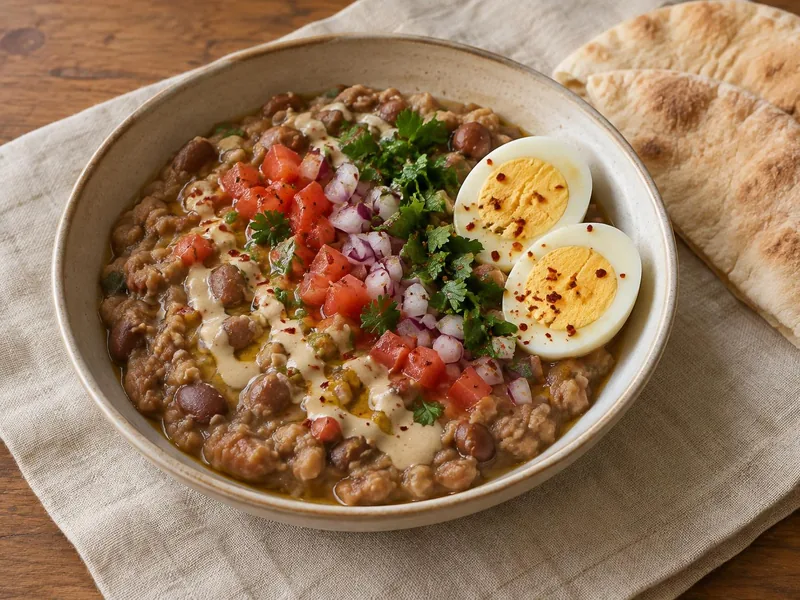
Ful Medames
Slow-simmered fava beans, roughly mashed with garlic, lemon and cumin, served warm with fresh tomato, parsley and good olive oil.
 AI-generated image
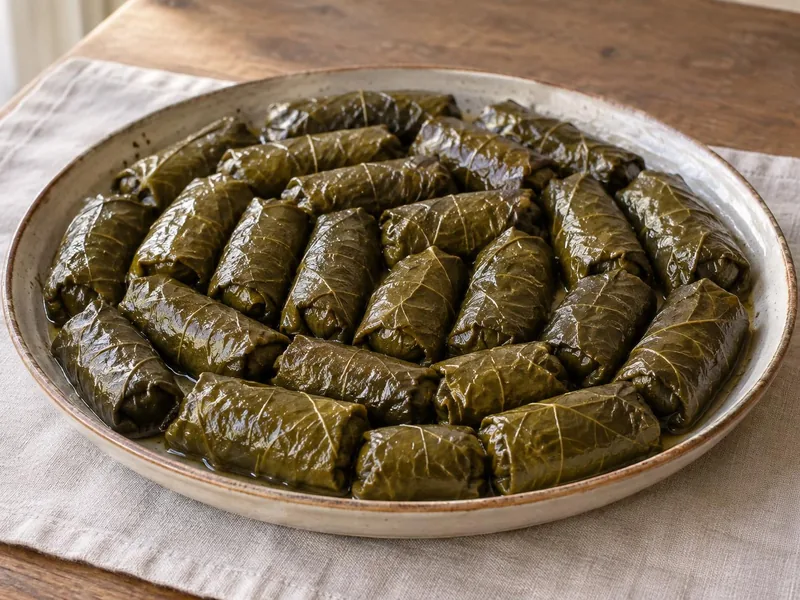
Stuffed Grape Leaves (Olive Oil Dolma)
Tender jarred grape leaves wrapped around a spiced rice, herb and pine nut filling, then simmered in olive oil and lemon until soft and glossy.
 AI-generated image
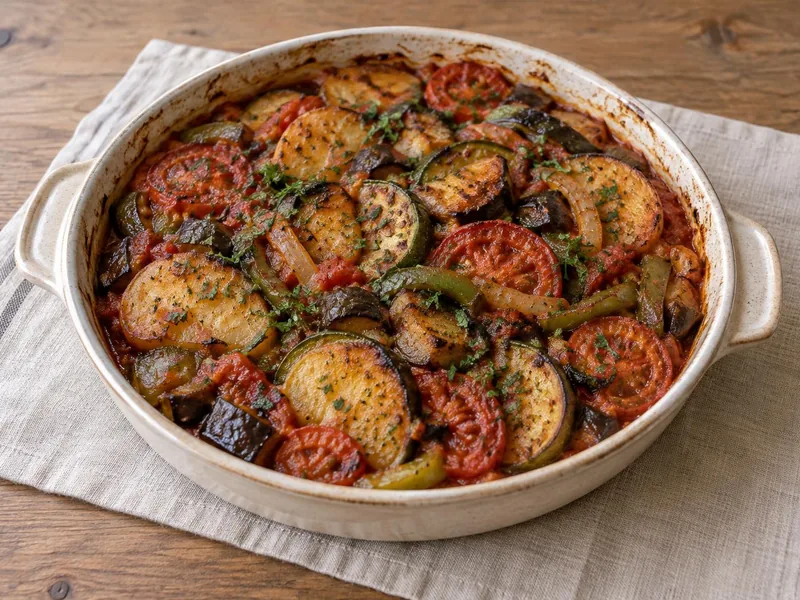
Briam (Greek Roasted Vegetables)
Potatoes, zucchini, eggplant, pepper and onion baked slowly in grated tomato and olive oil until soft, jammy and browned at the edges.