Stuffed Zucchini (Kabak Dolması)
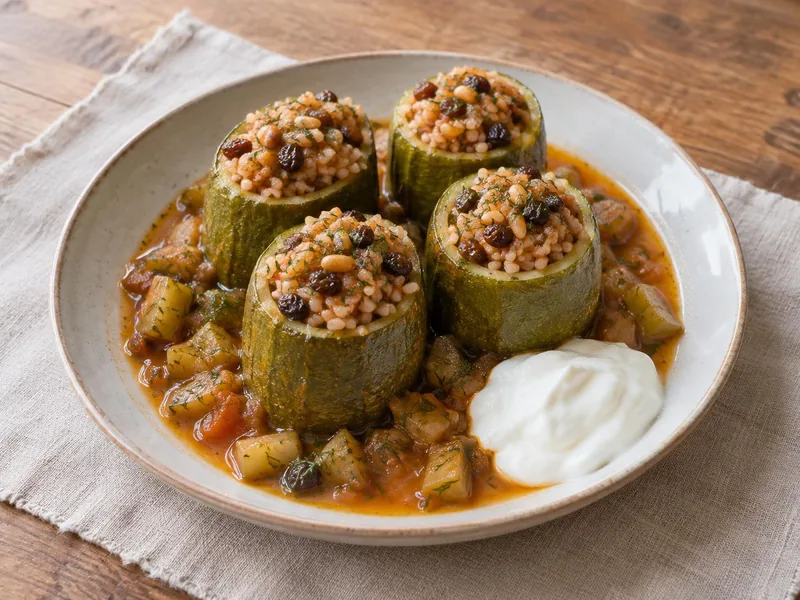
Zucchini pieces are hollowed, filled with a fragrant olive oil rice and herb mixture, then braised upright on a bed of their own flesh until silky and tender.
 AI-generated image
- 1000 gmedium zucchini
- 450 gscooped zucchini flesh
- 200 gwhole-milk yogurt
- 150 gscooped zucchini flesh
- 120 gyellow onion
Kabak dolması is a Turkish dish of hollowed zucchini (courgettes) packed with a savory filling and cooked slowly in a covered pot. Versions with ground meat are common. So are olive oil versions with rice, onion and herbs, which is the style made here.
Stuffed vegetables like this are eaten across Turkey and the wider Mediterranean, often as part of a meze spread or as a light main with yogurt. The rice version is usually served warm or at room temperature, which makes it easy to cook ahead.
This version works because of a few simple choices. Eight medium zucchini are cut in half crosswise and hollowed, which makes 16 short upright cups. The rice is partly cooked in the pan first, so it finishes tenderly in the pot, and each cup is filled only about three-quarters full to leave room for the rice to swell. The rest of the scooped flesh goes into the pot as a soft bed under the cups, so none of it is wasted. The cups stand snugly upright with a plate on top to hold them in place.
Preparation
- Step 013 min
Rinse the rice in a fine-mesh sieve under cold running water until the water runs mostly clear, then leave it to drain.
- Step 0210 min
Finely dice the onion, chop the garlic, parsley and dill, and halve and grate the tomato on a box grater, discarding the skin.
- Step 0320 min
Trim the stem end off each zucchini and cut each one in half crosswise to make 16 pieces. Use a corer or long thin spoon to hollow each piece from the cut end, leaving a wall about 5 mm (1/4 in) thick and a closed base about 1.5 cm (1/2 in) thick. Save all the scooped flesh (about 600 g).
- Step 045 min
Finely chop 150 g of the scooped flesh for the filling. Coarsely chop the remaining flesh (about 450 g) and set it aside for the pot.
- Step 058 min
Warm 40 g olive oil in a large frying pan over medium heat (about 160 C / 320 F), add the onion and cook, stirring, until soft and translucent but not browned.
- Step 062 min
Add the pine nuts and cook, stirring, until they turn light golden.
- Step 071 min
Stir in the garlic and 15 g tomato paste and cook until the paste darkens slightly and smells sweet.
- Step 082 min
Add the 150 g finely chopped zucchini flesh and cook until it begins to soften and release its liquid.
- Step 091 min
Add the drained rice, currants, grated tomato, 110 g water, 3 g salt, pepper, allspice and dried mint, and stir well.
- Step 1010 min
Bring to a simmer, cover, and cook over low heat until the liquid has been absorbed and the rice is partly cooked, still firm in the center when you bite a grain.
- Step 1110 min
Remove the pan from the heat, stir in the parsley and dill, and leave the filling to cool for 10 minutes so it is easy to handle.
- Step 122 min
Spread the coarsely chopped flesh in an even layer over the bottom of the pot and sprinkle with 1 g of the braising salt.
- Step 138 min
Divide the filling evenly among the 16 hollowed pieces, filling each no more than about three-quarters full, because the rice will swell as it cooks. If any filling is left over, stir it into the flesh bed in the pot rather than packing it in.
- Step 145 min
Stand the filled pieces upright, open end up, on the flesh bed, packing them snugly together so they support each other and stay level.
- Step 152 min
Before adding any liquid, set the heatproof plate upside down on top of the pieces so it rests lightly on the rims, then put the lid on. Check that the lid closes fully. If it does not, use a deeper pot before continuing.
- Step 16
Whisk 500 g boiling water with 30 g olive oil, 15 g tomato paste, the sugar, the remaining 2 g salt and about 20 g of the lemon juice. Lift the plate and pour the liquid carefully around the pieces without pouring into the filling. The liquid should come roughly one third of the way up the pieces; add a little more boiling water if it is lower. Set the plate back on top and cover with the lid.
- Step 1738 min
Bring to a gentle simmer over medium heat, then reduce to low (a bare simmer, around 95 C / 200 F) and cook for 35 to 40 minutes. Lift the lid after 15 minutes and again near the end; if the liquid has dropped to about 1.5 cm (1/2 in) or the base looks dry, add 50 g boiling water at a time.
- Step 182 min
Check that a thin knife slides into a zucchini wall with no resistance and a grain of rice from the filling is completely tender; if not, cook 5 minutes more.
- Step 1915 min
Turn off the heat and let the zucchini rest in the pot, covered, for 15 minutes so they firm up slightly before moving.
- Step 20
Lift the pieces out carefully with a wide spoon onto a platter, 4 per person, keeping them upright.
- Step 215 min
If a lot of liquid remains in the pot, simmer it with the soft zucchini bed, uncovered, over medium heat until it reduces to a light, spoonable sauce. The time depends on how much liquid there is, so go by the consistency rather than the clock. If there is only a little liquid, skip this step.
- Step 22
Spoon the soft zucchini bed and pan juices around the pieces and serve warm or at room temperature with yogurt and the remaining lemon juice.
Kitchen notes
- Choose firm zucchini of similar size so they cook at the same rate. Large, seedy zucchini turn watery and can collapse.
- Do not overfill. Fill the pieces no more than about three-quarters full. Rice swells during braising and can split the shells or push out of the openings if they are packed to the top.
- The wall and base thickness matter: scooping too thin splits the shells, and scooping too little leaves less room for filling. If your pieces hold less than expected, put the extra filling into the flesh bed rather than packing it in.
- The pot needs enough depth for the pieces (about 8.5 cm / 3.5 in tall), the flesh bed and the upside-down plate, with the lid fully closed. Check this before adding the hot liquid.
- If your pot is wider than 26 cm (10 in), crowd the pieces together in the center or add a little extra boiling water so they do not tip over.
- If you prefer a fuller, more filling-rich cup, you can use up to 100 g rice, adding a little more water to the filling, but keep each piece no more than three-quarters full.
- To store, refrigerate within 2 hours of cooking in a covered container for up to 3 days. Cooked rice should not sit at room temperature for longer than 2 hours.
- Reheat gently in a covered pan with a splash of water until steaming hot all the way through, or serve cold from the refrigerator.
- Variations: add a spoonful of chopped fresh mint, swap the currants for chopped dried apricots, or replace the pine nuts with chopped walnuts or leave them out for a nut-free dish.
- Stir a small grated garlic clove and a pinch of salt into the yogurt for a sharper side sauce.
Diet and allergens
Suitable for: Vegetarian, Gluten-free.
Contains: tree nuts, milk.
Labels come from the ingredient list by fixed rules. If you cook for someone with an allergy, check the labels of packaged ingredients such as stock, spice blends, tahini and bread, since brands differ. How labels work.
Frequently asked questions
Can I make kabak dolması ahead of time?
Yes. It tastes good at room temperature, so you can cook it a day ahead and refrigerate it within 2 hours of cooking. Reheat gently until steaming hot or serve cold.
Why is the rice cooked partly before stuffing?
Starting the rice in the pan gives it a head start and brings out the flavor of the onion and tomato. It then finishes cooking in the braising liquid without needing so much room that it splits the zucchini.
What happens to the rest of the scooped zucchini flesh?
A small part goes into the filling and the rest is chopped and spread in the bottom of the pot. It cooks down into a soft bed that you spoon over the stuffed zucchini when serving.
How do I keep the zucchini from falling apart?
Choose firm, evenly sized zucchini, keep the walls about 5 mm thick, and fill them only three-quarters full. Once cooked, rest them in the pot and lift them out with a wide spoon.
Are courgettes the same as zucchini?
Yes. Courgette is the UK name for zucchini. Choose firm, medium ones of even size for this recipe.
References and sources
- Nutrition: USDA FoodData Central records medium zucchini (courgettes), hollowed shells (FDC 169291), scooped zucchini flesh, for the filling (FDC 169291), extra virgin olive oil (FDC 171413), yellow onion (FDC 170000), pine nuts (FDC 170591), garlic (FDC 1104647), tomato paste (FDC 2685580), short-grain or medium-grain white rice (FDC 168879), dried currants (FDC 171724), ripe tomato (FDC 170457), water (FDC 173647), fine salt (FDC 173468), black pepper (FDC 170931), ground allspice (FDC 171315), dried mint (FDC 172239), fresh flat-leaf parsley (FDC 170416), fresh dill (FDC 172233), scooped zucchini flesh, for the pot (FDC 169291), boiling water (FDC 173647), extra virgin olive oil (FDC 171413), tomato paste (FDC 170459), granulated sugar (FDC 746784), fine salt (FDC 173468), lemon juice (FDC 167747), plain whole-milk yogurt (FDC 2259793).
- Proportions: main ingredients and salt per serving were compared with the median of 5 published recipes for this dish. How we make recipes.
 AI-generated image
Briam (Greek Roasted Vegetables)
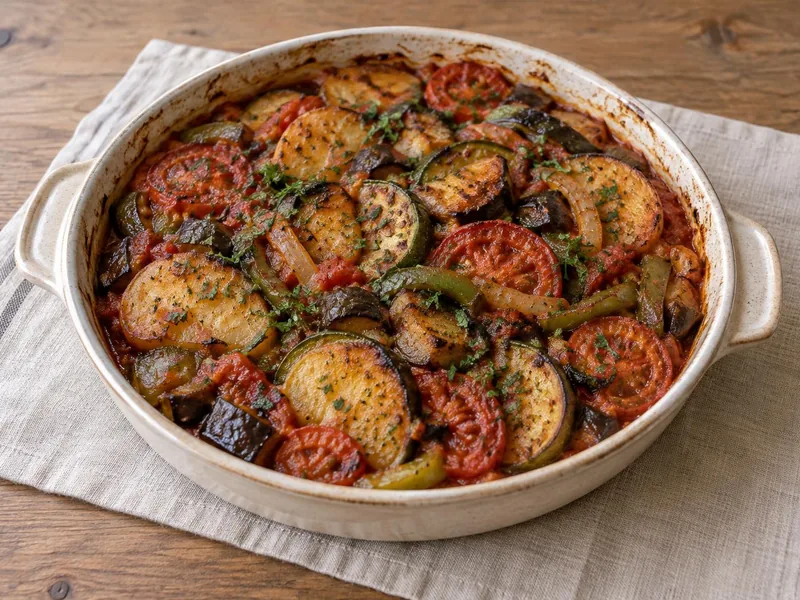
Potatoes, zucchini, eggplant, pepper and onion baked slowly in grated tomato and olive oil until soft, jammy and browned at the edges.
 AI-generated image
Okra in Tomato and Olive Oil (Bamya)
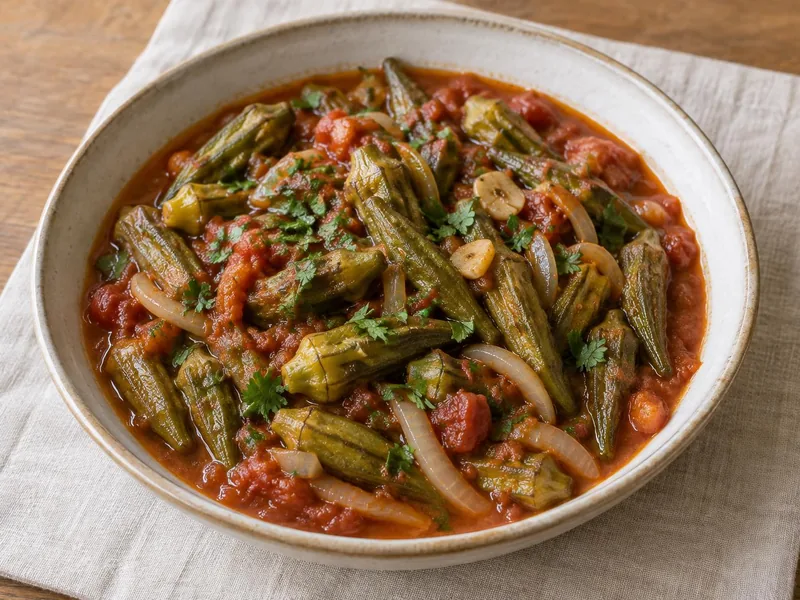
Whole okra pods are lightly browned, then braised gently in tomato and olive oil until tender, with a squeeze of lemon at the end.
 AI-generated image
Spanakopita
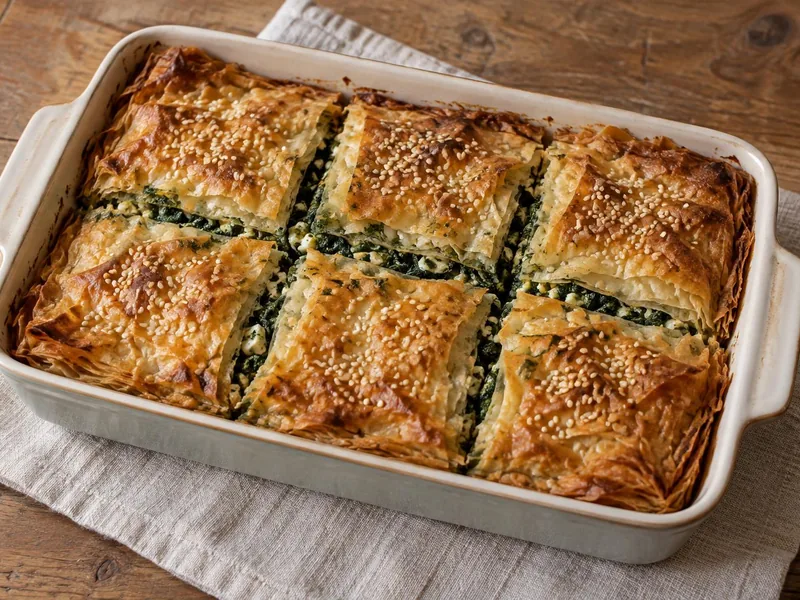
A crisp, flaky phyllo pie filled with spinach, feta and plenty of dill, baked until deeply golden.