Gözleme with Spinach and Feta
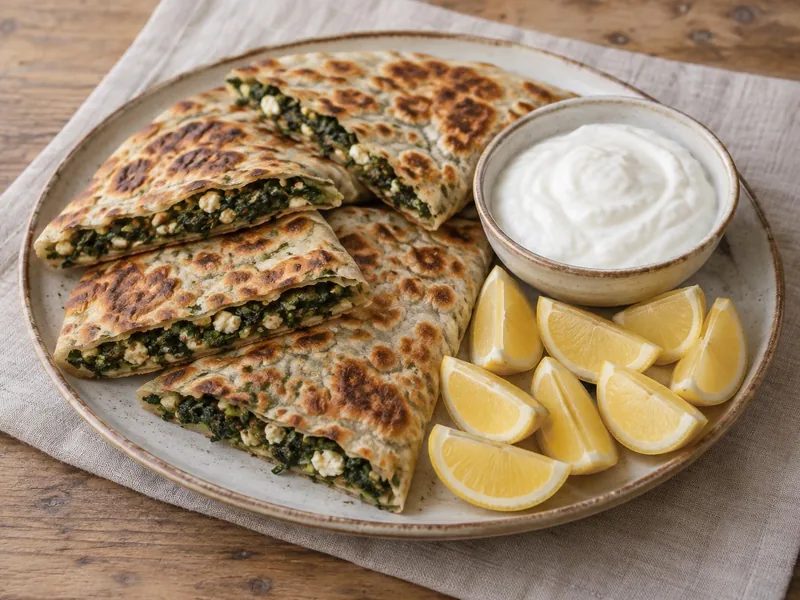
Paper-thin yogurt dough wrapped around salty feta and herby greens, then cooked in a hot skillet until blistered and crisp at the edges.
 AI-generated image
- 400 gplain
- 320 gfresh spinach
- 200 gfeta cheese
- 160 gwhole-milk yogurt
- 85 glemon
Gözleme is a Turkish flatbread that is rolled very thin, filled, folded and cooked on a griddle. Spinach and cheese is one of the most familiar fillings, and potato, minced meat and herb versions are also common. It is often made at home and sold at markets and roadside stalls, usually cooked to order and eaten hot.
This version uses a soft dough with a little yogurt and olive oil, which rolls out thinly without springing back. The spinach is salted, left to release its water, then squeezed hard, so the filling stays bright and does not make the dough soggy. Feta provides the salt and tang, while spring onions, parsley and dill keep the filling fresh.
You need only a rolling pin and a wide skillet with a flat base. The dough rests for 30 minutes so it relaxes, then it is divided into 6 pieces and rolled until you can nearly see the work surface through it. Each folded half-moon is about 24 cm / 9.5 in across its straight edge, so it lies flat on the pan. While one gözleme cooks you roll and fill the next, so the whole batch takes about 30 minutes at the stove. Serve straight from the pan with lemon wedges and cold yogurt.
Preparation
- Step 013 min
Make the dough: in a large bowl, stir together the flour and the 5 g salt for the dough. Add the water, the 60 g yogurt for the dough and the 15 g olive oil, and mix with your hand until no dry flour remains.
- Step 025 min
Knead on a lightly floured surface for about 5 minutes, until the dough is smooth, soft and slightly tacky but not sticking to your hands. Add a spoonful of flour only if it clings stubbornly.
- Step 0330 min
Shape the dough into a ball, cover the bowl with a damp towel or a lid, and leave it at room temperature for 30 minutes. The dough should feel relaxed and stretch easily when you press it.
- Step 0410 min
While the dough rests, put the chopped spinach in a colander, sprinkle with the 1.5 g salt for the spinach and toss well. Leave for 10 minutes so it releases its liquid.
- Step 053 min
Squeeze the spinach in handfuls, then wrap it in a clean towel and twist hard to remove as much water as possible. It should feel damp, not wet, and no liquid should drip when you squeeze it.
- Step 063 min
In a bowl, combine the squeezed spinach, crumbled feta, spring onions, parsley, dill, pul biber and black pepper. Toss with your fingers to break up any clumps of spinach, then divide the filling into 6 equal portions.
- Step 072 min
Divide the rested dough into 6 equal pieces of about 110 g each and roll them into balls. Keep them covered with a towel so they do not dry out.
- Step 083 min
Dust the work surface lightly with flour. Roll one ball into a thin round about 24 cm / 9.5 in across, flipping and dusting as needed. The dough should be about 2 mm thin, so you can just see the surface through it.
- Step 092 min
Scatter one portion of filling over one half of the round, leaving a 2 cm / 3/4 in border at the edge. Fold the empty half over the filling and press the edges together firmly to seal. The folded half-moon should be about 24 cm / 9.5 in across its straight edge and lie completely flat.
- Step 102 min
Heat the skillet over medium-high heat (about 200 C / 400 F on the surface) for 2 minutes. Brush the flat base very lightly with some of the olive oil for cooking.
- Step 115 min
Lay the gözleme in the pan, making sure all the edges touch the flat base, and cook for 2 to 3 minutes, until the underside is golden with brown blisters. Brush the top with a little oil, flip, and cook for about 2 minutes more, until the second side is golden and the dough is cooked through with no raw, doughy patches.
- Step 1225 min
While each gözleme cooks, roll and fill the next one, so it is ready to go into the pan as soon as the previous one comes out. Keep the cooked gözleme warm on a baking sheet in a 90 C / 200 F oven. Brush the pan lightly with oil before each one, and lower the heat to medium if the pan starts to smoke or the dough browns before it cooks through. All 6 take about 25 to 30 minutes at the stove. If rolling and cooking at the same time feels rushed, move the pan off the heat while you finish rolling.
- Step 132 min
Cut each gözleme into 2 or 3 pieces with a sharp knife, so each person gets one and a half gözleme. Serve hot with the lemon wedges and cold yogurt.
- Step 14
Refrigerate leftovers in a covered container within 2 hours of cooking, or within 1 hour if the room is above 32 C (90 F).
Kitchen notes
- Squeeze the spinach well. Excess water is the main cause of soggy, torn gözleme.
- This makes 6 gözleme, about 1.5 per person. The flat part of the pan base matters more than its stated diameter, so measure it. A folded half-moon wider than the flat base will have raw edges.
- If your flat pan base is smaller than 25 cm / 10 in, divide the dough and filling into 8 pieces instead, roll each to about 20 cm / 8 in, and use a base of at least 21 cm / 8.5 in. Cook them in the same way, allowing about 10 minutes more in total.
- Make ahead: the dough balls keep covered in the refrigerator for up to 24 hours. Bring them to room temperature for 30 minutes before rolling.
- Storage: refrigerate leftovers within 2 hours of cooking and eat within 3 days. Reheat in a dry skillet over medium heat for about 3 minutes per side, until steaming hot all the way through and crisp again.
- Variations: replace half of the feta with crumbled white cheese or ricotta for a milder filling, again choosing a cheese made with microbial or plant-based rennet, or use the same weight of finely chopped chard instead of the spinach.
- Vegan version: all three dairy ingredients need replacing. Use the same weight of plain unsweetened plant-based yogurt in the dough (or 60 g extra water), replace the feta with 200 g firm tofu crumbled with 15 g lemon juice and 3 g extra salt, and serve with plant-based yogurt or no yogurt at all. Cook with olive oil only.
- Allergens: the dough contains wheat gluten, and the yogurt and feta contain milk. The vegan tofu swap contains soy.
- If the dough springs back while rolling, cover it and let it rest for 5 more minutes, then continue.
Diet and allergens
Suitable for: Vegetarian, Nut-free.
Contains: milk, gluten (wheat).
Labels come from the ingredient list by fixed rules. If you cook for someone with an allergy, check the labels of packaged ingredients such as stock, spice blends, tahini and bread, since brands differ. How labels work.
Frequently asked questions
Can I use frozen spinach?
Yes. Use about 200 g frozen chopped spinach, thaw it fully and squeeze it very dry in a towel. Skip the salting step and use the same amount of feta.
Why is my gözleme dough tearing?
The dough is probably too dry or has not rested long enough. Rest it covered for another 10 minutes, and roll with a light dusting of flour rather than adding a lot, which dries it out.
Can I make gözleme without a rolling pin?
A long, thin rolling pin gives the best result, but a clean wine bottle also works. Roll from the center outward and rotate the dough often.
Is gözleme vegetarian?
This recipe is, because it calls for feta made with microbial or plant-based rennet. Many fetas use animal rennet, so check the label before you buy.
Can I make it vegan?
Yes, but the yogurt in the dough, the feta and the serving yogurt all need replacing, as described in the vegan note. Cook with olive oil only. The texture and flavor will differ from the original.
References and sources
- Nutrition: USDA FoodData Central records Plain (all-purpose) flour (FDC 168894), Lukewarm water (FDC 173647), Whole-milk yogurt (FDC 2259793), Olive oil (FDC 171413), Fine salt (FDC 173468), Fresh spinach (FDC 168462), Fine salt (FDC 173468), Feta cheese, labeled vegetarian (made with microbial or plant-based rennet) (FDC 173420), Spring onions (scallions) (FDC 170005), Flat-leaf parsley (FDC 170416), Fresh dill (FDC 172233), Pul biber (Turkish chili flakes) (FDC 170932), Black pepper (FDC 170931), Olive oil, for cooking (FDC 171413), Lemon (FDC 167746), Whole-milk yogurt (FDC 2259793).
- Proportions: main ingredients and salt per serving were compared with the median of 4 published recipes for this dish. How we make recipes.
 AI-generated image
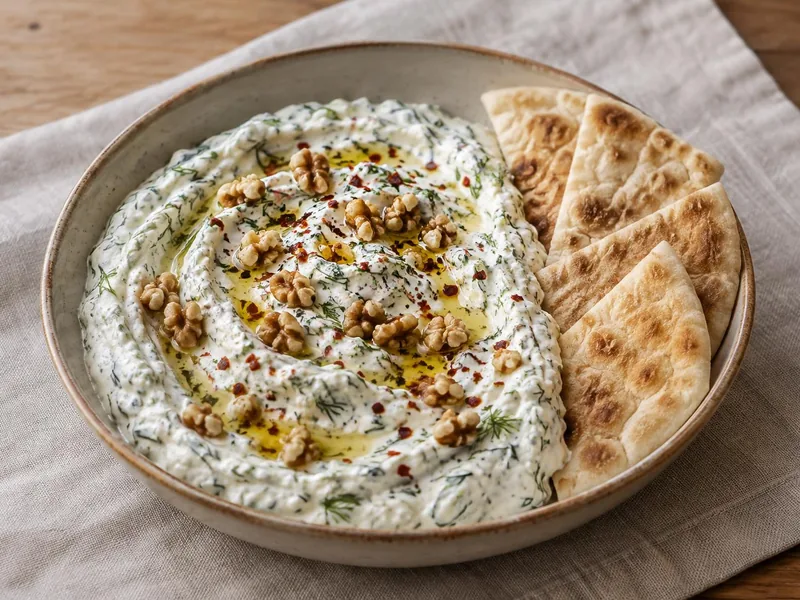
Haydari (Turkish Yogurt and Herb Dip)
A thick, cool meze of strained yogurt, raw garlic, dill and mint, finished with toasted walnuts and good olive oil.
 AI-generated image
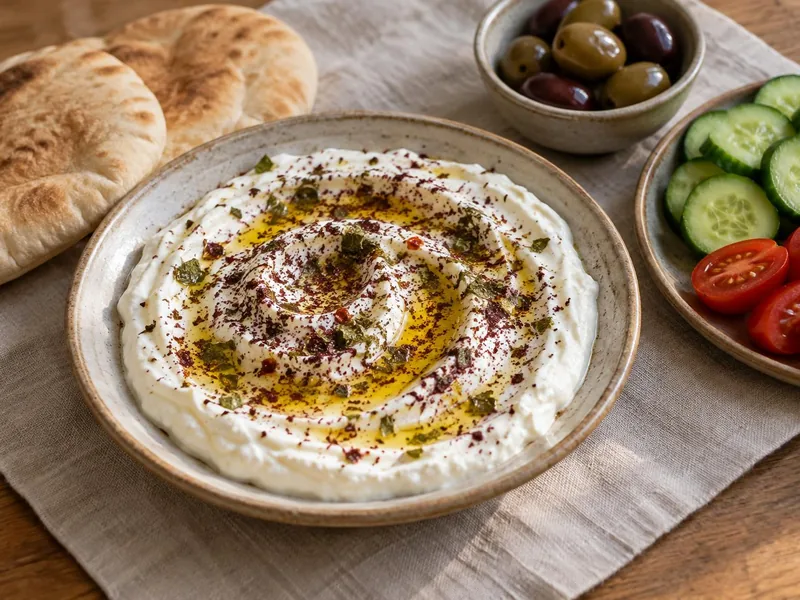
Labneh
Thick, tangy strained yogurt that needs only two ingredients and a night in the refrigerator.
 AI-generated image
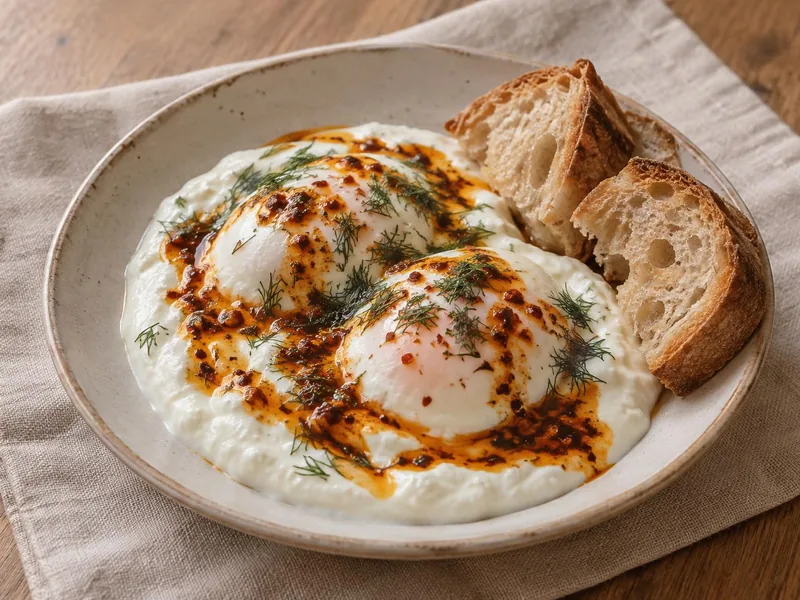
Turkish Eggs (Çılbır)
Silky poached eggs rest on cool garlic yogurt under a spoonful of warm, chile-red butter, with runny yolks for pasteurized eggs or fully set yolks for any eggs.