Turkish Eggs (Çılbır)
Silky poached eggs rest on cool garlic yogurt under a spoonful of warm, chile-red butter, with runny yolks for pasteurized eggs or fully set yolks for any eggs.
 AI-generated image
- 400 gthick whole-milk yogurt
- 400 glarge eggs
- 200 gcrusty bread or pide
- 60 gunsalted butter
- 30 gwhite distilled vinegar
Çılbır (pronounced roughly chul-bur) is a Turkish dish of poached eggs served over garlicky yogurt and finished with melted butter colored by red pepper flakes. It is a familiar sight at breakfast tables and brunch spots across Turkey, and it also works well as a light lunch or supper with good bread.
The dish is all about contrasts: cool, tangy yogurt against warm eggs, and a rich, lightly spicy butter over the top. This version lets the yogurt stand at room temperature for 30 minutes so it does not chill the eggs. That wait is passive, so plan on about 70 minutes from start to table. A wide pot with about 5 cm (2 in) of gently simmering water and a little vinegar keeps the whites tidy, and the butter is warmed just until it foams so the pepper turns fragrant without burning.
Runny yolks need pasteurized in-shell eggs. With ordinary eggs, poach until the whites and yolks are completely firm, which the recipe gives as the other option. Serve with plenty of warm, crusty bread or pide for scooping, and finish with dill for a fresh green note.
Preparation
- Step 0130 min
Take the yogurt out of the refrigerator and leave it at room temperature for 30 minutes, until it is no longer fridge-cold. Do not leave it out for more than 2 hours.
- Step 023 min
Stir the yogurt, grated garlic and 2.5 g salt together in a bowl until smooth and loose enough to spread. Divide among 4 shallow plates or bowls and spread into a thick, even layer with a shallow well in the center.
- Step 032 min
Crack 1 egg into each of the 4 ramekins, taking care not to break the yolks. Set them next to the stove. Keep the other 4 eggs in the refrigerator until the first batch is poaching.
- Step 0410 min
Pour the water and vinegar into the wide pot, about 24 cm (9.5 in) across. The water should be about 5 cm (2 in) deep, so add or pour off a little if your pot is a different size. Heat until it just simmers, with small bubbles rising slowly, about 90 to 95 C (195 to 203 F). Do not let it boil hard, and do not stir it into a whirlpool, since the eggs are poached in spaced-out batches.
- Step 0510 min
Lower the lip of one ramekin right to the water surface and tip the egg in gently. Repeat with the other 3 ramekins, placing the eggs well apart so they do not touch. With pasteurized in-shell eggs, poach for about 3 minutes for runny yolks, until the whites are opaque and just set and the yolks still jiggle when nudged. With ordinary eggs, poach for about 8 to 10 minutes, until the whites are completely opaque and firm and the yolks feel firm when pressed gently with the spoon. If in doubt, lift one out and cut into it: no liquid yolk or translucent white should remain.
- Step 0610 min
Lift the eggs out one at a time with the slotted spoon and rest the spoon briefly on a kitchen towel to drain. Set 2 eggs on each of 2 plates of yogurt. Crack the remaining 4 eggs into the empty ramekins, one per ramekin, and poach and drain them the same way, using the same timing.
- Step 073 min
During the last 3 minutes of the second batch, melt the butter in the small saucepan over medium-low heat until it foams and smells lightly nutty, about 2 minutes. Remove from the heat, stir in the Aleppo pepper and swirl for 15 to 20 seconds, until the butter turns deep red and fragrant. Do not let it darken or smell scorched.
- Step 081 min
Make sure each plate has 2 drained eggs on the yogurt. Sprinkle a small pinch of the 1 g egg salt over each egg, then spoon the warm pepper butter over the eggs and yogurt. Sprinkle with dill and serve immediately with warm bread for scooping.
Kitchen notes
- Poached eggs are best cooked fresh and served right away, and the yogurt should stay cool, not hot. This recipe is not designed for poaching eggs ahead and reheating them, because reheating can leave the centers underheated and firms up the yolks.
- The garlic yogurt can be made up to 1 day ahead. Refrigerate it within 2 hours of making and let it stand about 30 minutes before serving, never more than 2 hours at room temperature.
- Very fresh eggs do not remove the risk of Salmonella. Runny yolks should only be served when you use pasteurized in-shell eggs. With ordinary eggs, poach until both white and yolk are completely firm.
- Anyone pregnant, elderly, very young or with a weakened immune system should eat eggs cooked until both white and yolk are completely firm, even if the eggs are pasteurized. Apply the same rule to any soft-boiled alternative.
- The poaching water is unsalted and the butter is unsalted, so the small pinch of salt on each egg matters. Taste the yogurt and add a little more salt if you like.
- For a green variation, add a small handful of chopped mint or parsley to the yogurt, or swap the dill for either.
- If your garlic is very strong, grate it and let it stand with the salt for 5 minutes before stirring it into the yogurt for a softer bite.
Diet and allergens
Suitable for: Vegetarian, Nut-free.
Contains: milk, egg, gluten.
Labels come from the ingredient list by fixed rules. If you cook for someone with an allergy, check the labels of packaged ingredients such as stock, spice blends, tahini and bread, since brands differ. How labels work.
Frequently asked questions
How do I keep poached eggs from spreading out in the water?
Use very fresh eggs, keep the water at a gentle simmer rather than a boil, and tip each egg in from a ramekin held right at the water surface. Space the eggs apart in a wide pot with about 5 cm (2 in) of water, and the splash of vinegar helps the whites set quickly.
Can I make çılbır with soft-boiled eggs instead?
Yes. With pasteurized in-shell eggs, boil for about 6 to 7 minutes, cool briefly in cold water, peel and halve them over the yogurt for soft yolks. With ordinary eggs, boil for about 10 minutes until the yolks are completely firm.
What can I use if I cannot find Aleppo pepper?
A mix of sweet paprika and a little crushed red pepper flakes gives similar color and mild heat. Start with less and add more to taste, since flake heat varies.
Should the yogurt be warm or cold?
Aim for cool room temperature. Ice-cold yogurt cools the eggs quickly, and warming it over heat can make it split, so letting it stand out for 30 minutes works best.
Do I need pasteurized eggs?
Only if you want runny yolks. Pasteurized in-shell eggs are the safer choice for a soft yolk, while ordinary eggs should be poached about 8 to 10 minutes until the whites and yolks are completely firm.
References and sources
- Nutrition: USDA FoodData Central records thick plain whole-milk yogurt (Greek-style) (FDC 2259794), garlic (FDC 1104647), fine salt, for the yogurt (FDC 173468), large eggs (FDC 171287), water for poaching (FDC 173647), white distilled vinegar (FDC 172237), fine salt, for the eggs (FDC 173468), unsalted butter (FDC 173430), Aleppo pepper (pul biber) (FDC 170932), fresh dill (FDC 172233), crusty bread or pide (FDC 174913).
- Proportions: main ingredients and salt per serving were compared with the median of 5 published recipes for this dish. How we make recipes.
 AI-generated image
Gözleme with Spinach and Feta
Paper-thin yogurt dough wrapped around salty feta and herby greens, then cooked in a hot skillet until blistered and crisp at the edges.
 AI-generated image
Haydari (Turkish Yogurt and Herb Dip)
A thick, cool meze of strained yogurt, raw garlic, dill and mint, finished with toasted walnuts and good olive oil.
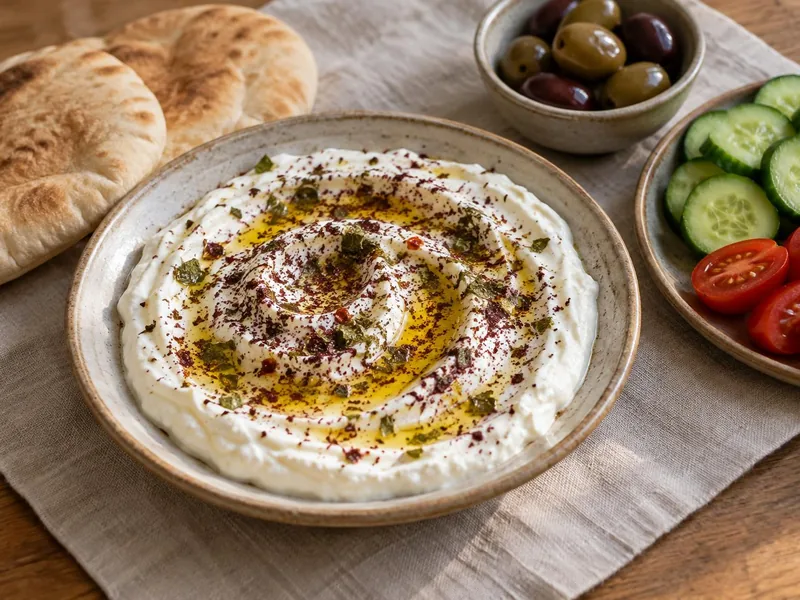 AI-generated image
Labneh
Thick, tangy strained yogurt that needs only two ingredients and a night in the refrigerator.