Tabbouleh
A bright, herb-heavy salad where parsley is the main green and fine bulgur is just a seasoning grain.
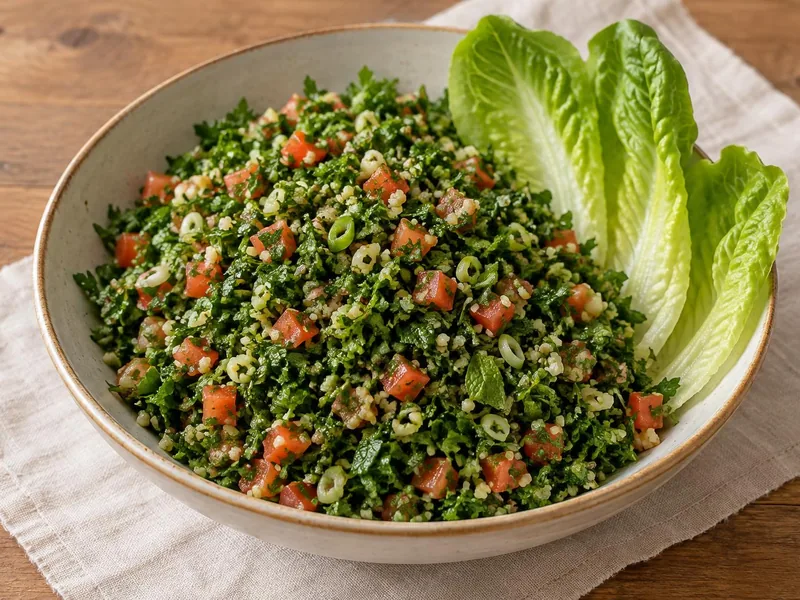 AI-generated image
- 300 gripe tomatoes
- 100 gflat-leaf parsley
- 100 ginner romaine lettuce leaves
- 60 gspring onions
- 60 glemon juice
Tabbouleh is a chopped parsley salad eaten across the Levant and well beyond, usually as part of a meze spread or alongside grilled vegetables, flatbread and dips. The proportions matter: it is a parsley salad with a little bulgur, not a grain salad with a few herbs.
This version uses a generous heap of flat-leaf parsley, a modest handful of mint, ripe tomatoes, spring onions and just 40 g of fine bulgur. The bulgur is rinsed and then softened in the tomato juice and lemon juice rather than boiled, so it stays tender but slightly chewy and carries the flavor of the dressing.
Two habits make the difference. Dry the herbs thoroughly before chopping so they cut cleanly instead of bruising into a wet paste. Then toss with the oil just before serving so the parsley stays bright green and the salad does not turn watery.
Preparation
- Step 012 min
Rinse the bulgur in a fine-mesh sieve under cold running water for about 30 seconds, then shake off as much water as you can and tip it into a large mixing bowl.
- Step 0220 min
Dice the tomatoes into 6 mm (1/4 inch) pieces on a board with a lip so you can catch the juice. Add the tomatoes and all their juice to the bulgur, along with the salt and half of the lemon juice (30 g). Stir and leave to stand at room temperature for 20 minutes, until the bulgur is tender with a slight chew and no hard, chalky center when you bite a few grains.
- Step 038 min
While the bulgur softens, wash the parsley and mint in plenty of cold water, then dry them completely in a salad spinner or by rolling them in a clean tea towel. Wet herbs turn to paste when chopped, so they should feel dry to the touch.
- Step 048 min
Pick the parsley leaves and thin tender stems from the thick stalks and discard the stalks. Gather the parsley into a tight bunch and slice it very thinly with a sharp knife, then run the knife through it once or twice more to chop it finely. Stop before it looks wet or mushy.
- Step 053 min
Chop the mint finely, using the same method, and slice the spring onions thinly.
- Step 062 min
Add the parsley, mint and spring onions to the bowl with the bulgur and tomatoes. Add the remaining lemon juice (30 g), the olive oil, black pepper and allspice if using. Toss gently with two forks until everything is evenly coated and the herbs look glossy.
- Step 071 min
Taste and adjust with a pinch more salt or a squeeze more lemon until it tastes bright and well seasoned. Serve right away, piled in a bowl with the romaine leaves alongside for scooping.
Kitchen notes
- Serve within about 30 minutes of dressing for the best color and texture. Parsley darkens and softens as it sits in lemon juice.
- Food safety: count all the time the salad spends out of the refrigerator, including the bulgur soaking, preparation and serving, as one total. Keep it to 2 hours at most, or 1 hour if the room or table is warmer than 32 C (90 F). Serving does not restart the clock. If that time has passed, discard the salad.
- Leftovers that were kept within that time limit can be stored covered in the refrigerator at 4 C (40 F) and eaten within 2 days. They will be softer and wetter, so drain off excess liquid and refresh with a little lemon juice and salt.
- To make ahead, keep the soaked bulgur and tomato mixture in one covered container and the chopped, dry herbs and spring onions in another in the refrigerator at 4 C (40 F). Combine with the oil and remaining lemon juice just before serving.
- If your tomatoes are not very juicy and the bulgur still feels hard after 20 minutes, stir in 1 to 2 tablespoons (15 to 30 g) of cold water and leave it for 5 more minutes. This extra time counts toward the room-temperature total above.
- Variations: add a small handful of finely chopped cucumber for crunch, or use more bulgur (up to 80 g) for a heartier, more grain-forward salad. For a more herb-heavy salad, increase the parsley to 150 g. The recipe is vegan as written.
Diet and allergens
Suitable for: Vegan, Vegetarian, Dairy-free, Nut-free.
Contains: gluten (wheat).
Labels come from the ingredient list by fixed rules. If you cook for someone with an allergy, check the labels of packaged ingredients such as stock, spice blends, tahini and bread, since brands differ. How labels work.
Frequently asked questions
Why is there so little bulgur in tabbouleh?
Traditionally tabbouleh is a parsley salad, with bulgur used in small amounts as a soft, chewy accent. If you want more grain, increase it gradually and add a little extra lemon and salt.
Do I need to cook the bulgur?
No. Fine bulgur has already been steamed and dried, so rinsing it and letting it stand in tomato and lemon juice for about 20 minutes is enough to soften it. Coarser grades need boiling water or simmering, so use fine (number 1) for this recipe.
Is tabbouleh gluten-free?
No. Bulgur is cracked wheat, so this salad contains wheat and gluten and is not suitable for a wheat allergy or gluten-free diet.
How do I stop tabbouleh from getting watery?
Dry the washed herbs completely, dice the tomatoes rather than mashing them, and add the olive oil and final lemon juice just before serving. Drain off any pooled liquid if you serve leftovers.
Can I use curly parsley?
Flat-leaf parsley has a smoother, more tender texture and a stronger flavor, and is the better choice here. Curly parsley will work if it is all you can get, but chop it very finely.
References and sources
- Nutrition: USDA FoodData Central records Fine bulgur (number 1) (FDC 170688), Ripe tomatoes (FDC 170457), Flat-leaf parsley (FDC 170416), Fresh mint leaves (FDC 173475), Spring onions (scallions) (FDC 170005), Lemon juice (FDC 167747), Extra virgin olive oil (FDC 171413), Fine sea salt (FDC 173468), Black pepper (FDC 170931), Ground allspice (FDC 171315), Small inner romaine lettuce leaves (FDC 746769).
- Proportions: main ingredients and salt per serving were compared with the median of 4 published recipes for this dish. How we make recipes.
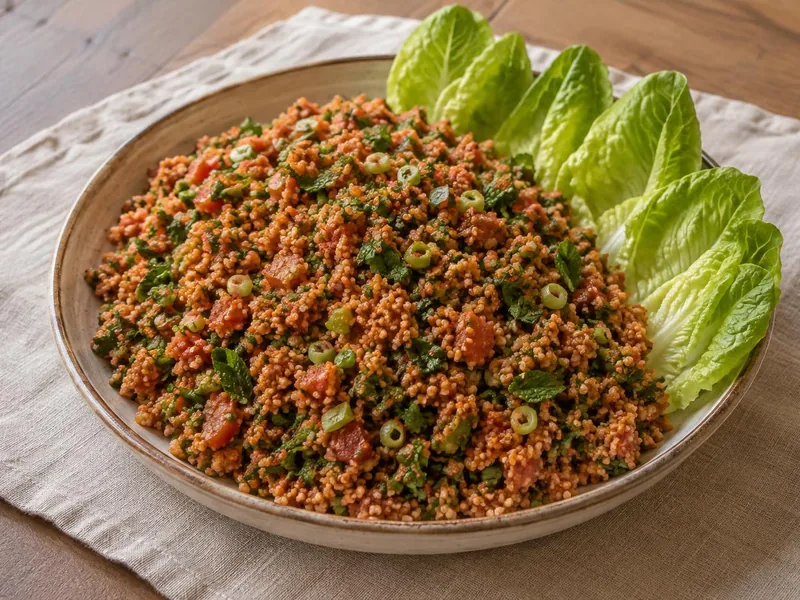 AI-generated image
Kısır (Turkish Bulgur Salad)
Fine bulgur is steeped in tomato and pepper paste, then tossed with olive oil, lemon, pomegranate molasses and plenty of fresh herbs.
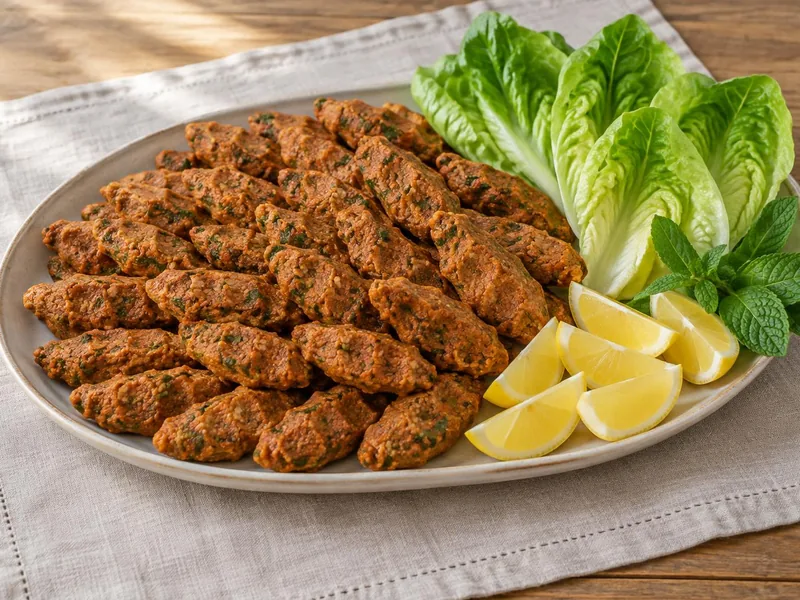 AI-generated image
Çiğ Köfte (Meatless Bulgur Köfte)
Fine bulgur softened in just-boiled water is kneaded with pepper paste, smoky isot pepper, onion and pomegranate molasses, then squeezed into small pieces to wrap in lettuce with lemon.
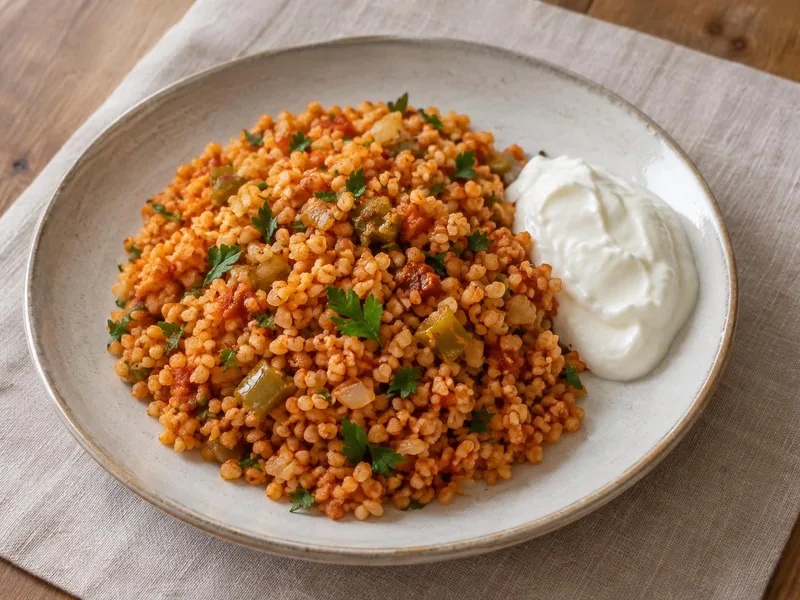 AI-generated image
Bulgur Pilaf
A one-pot Turkish bulgur pilavı, built on softened onion, pepper and tomato, with fluffy grains that stay separate.