Tzatziki
A thick, cool yogurt and cucumber dip with garlic, lemon and dill that stays creamy instead of watery.
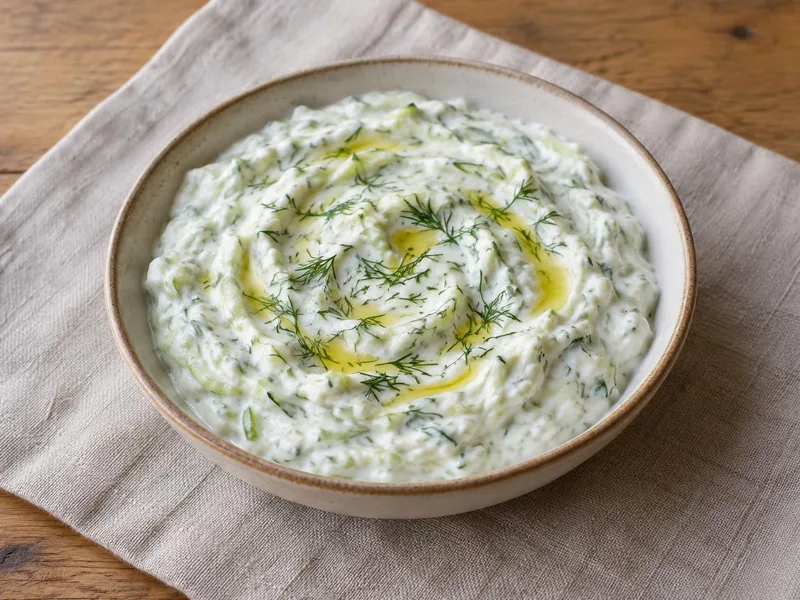 AI-generated image
- 400 gthick strained greek-style yogurt
- 300 gcucumber
- 20 gextra virgin olive oil
- 20 glemon juice
- 8 gfresh dill
Tzatziki is a cold dip or sauce of strained yogurt, cucumber, garlic, olive oil and herbs. Versions of it are found across Greece and Turkey (where the close relative is called cacik, often thinner and served in a bowl), and similar yogurt and cucumber mixtures appear throughout the eastern Mediterranean and beyond. It is served as part of a meze spread, with warm bread, alongside grilled vegetables, fritters and roasted potatoes, or spooned over rice and flatbreads.
The common problem with homemade tzatziki is wateriness. Cucumber is mostly water, and it leaks into the yogurt as the dip sits. This version salts the grated cucumber first, then squeezes it dry in a clean towel, so the dip stays thick for days rather than turning into a puddle.
Garlic is crushed to a paste with a little salt so it spreads evenly instead of leaving sharp raw chunks, and the dip rests in the refrigerator before serving so the flavors settle. Use full-fat strained Greek-style yogurt for the best body.
Preparation
- Step 0120 min
Coarsely grate the cucumber into a colander set over a bowl or in the sink. Toss with the 2 g of salt for the cucumber and leave it to drain for 20 minutes. It should look wet and slightly softened.
- Step 023 min
While the cucumber drains, put the garlic in a small bowl or mortar with a pinch of the seasoning salt. Crush and grind with the back of a spoon or a pestle until it forms a smooth paste with no visible chunks.
- Step 033 min
Tip the cucumber into the center of a clean thin kitchen towel, gather the corners and twist hard over the sink. Keep squeezing until it stops dripping and the cucumber feels like a damp, compact clump. Expect to lose roughly a third of its weight as liquid.
- Step 042 min
In a medium bowl, stir the yogurt with the garlic paste, 15 g of the olive oil and the lemon juice until smooth and evenly mixed.
- Step 051 min
Fluff the squeezed cucumber apart with your fingers and fold it into the yogurt along with most of the chopped dill. Keep a pinch of dill back for the top.
- Step 061 min
Taste and add more of the seasoning salt, a little pepper if you like, or a few drops more lemon juice. The dip should taste clearly of garlic and lemon but still be cool and mild. Remember that the flavors deepen as it chills.
- Step 0730 min
Cover and refrigerate at 4 C (40 F) or below for at least 30 minutes, so the garlic mellows and the flavors blend.
- Step 081 min
Stir once, spoon into a shallow serving bowl, make a few swirls with the back of the spoon, then drizzle with the remaining 5 g olive oil and scatter with the reserved dill. Serve cold.
Kitchen notes
- Storage: refrigerate within 2 hours of making or serving, in a covered container at 4 C (40 F) or below. It keeps well for up to 3 days. Do not leave it out on the table for more than 2 hours (1 hour in a hot room).
- A little liquid may gather on top after a day. Stir it back in or pour it off before serving.
- Make-ahead: the dip tastes best after a few hours in the refrigerator, but the garlic grows stronger the longer it sits. Use 1 clove if you plan to keep it for more than a day.
- For a thinner, Turkish-style cacik, stir in 100 to 150 g cold water and a little extra mint, and serve in bowls with a spoon.
- Variations: add 5 g chopped fresh mint, a pinch of dried oregano, or a few chopped olives. Serve with warm pita, grilled vegetables, fritters, roasted potatoes or rice.
- Dairy-free option: use a thick unsweetened plain soy or coconut yogurt, but expect a looser texture and add the lemon juice gradually.
Diet and allergens
Suitable for: Vegetarian, Gluten-free, Nut-free.
Contains: milk.
Labels come from the ingredient list by fixed rules. If you cook for someone with an allergy, check the labels of packaged ingredients such as stock, spice blends, tahini and bread, since brands differ. How labels work.
Frequently asked questions
Why is my tzatziki watery?
The cucumber is the usual cause. Salt the grated cucumber, let it drain, and squeeze it firmly in a towel before mixing. Using loose, unstrained yogurt also makes the dip thin.
Do I have to peel the cucumber?
No. Thin-skinned cucumbers can be left unpeeled for flecks of green and extra texture. Peel it if the skin is thick, bitter or waxed, and scoop out large watery seeds.
Can I use regular yogurt instead of Greek yogurt?
Yes, but strain it first. Spoon it into a sieve lined with a clean cloth and refrigerate for 1 to 2 hours until it is thick and spoonable.
Can I freeze tzatziki?
It is not recommended. The yogurt separates and the cucumber turns soft and watery when thawed. It is best made fresh and kept refrigerated for up to 3 days.
References and sources
- Nutrition: USDA FoodData Central records Cucumber (FDC 168409), Fine salt, for the cucumber (FDC 173468), Thick strained Greek-style yogurt, full fat, plain (FDC 171304), Garlic (FDC 169230), Fine salt, for seasoning (FDC 173468), Extra virgin olive oil (FDC 171413), Lemon juice, freshly squeezed (FDC 167747), Fresh dill (FDC 172233), Black pepper, freshly ground (FDC 170931).
- Proportions: main ingredients and salt per serving were compared with the median of 2 published recipes for this dish. How we make recipes.
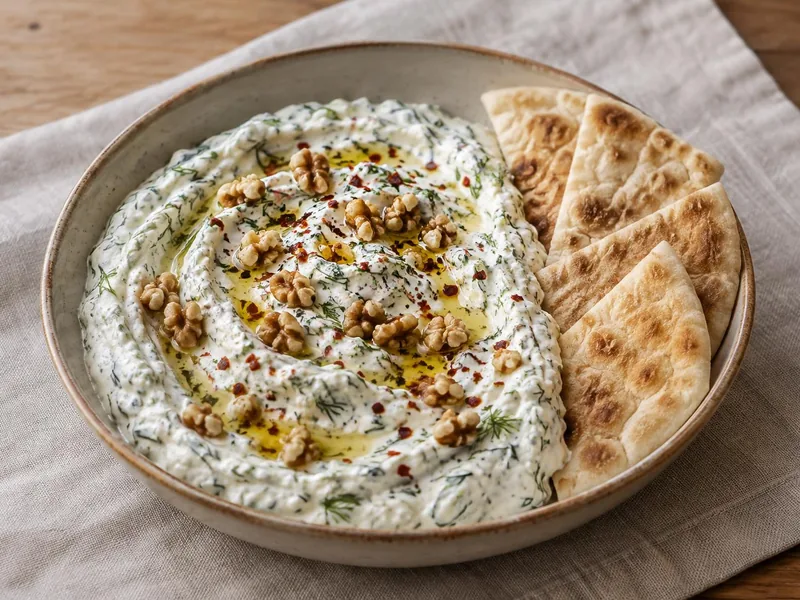 AI-generated image
Haydari (Turkish Yogurt and Herb Dip)
A thick, cool meze of strained yogurt, raw garlic, dill and mint, finished with toasted walnuts and good olive oil.
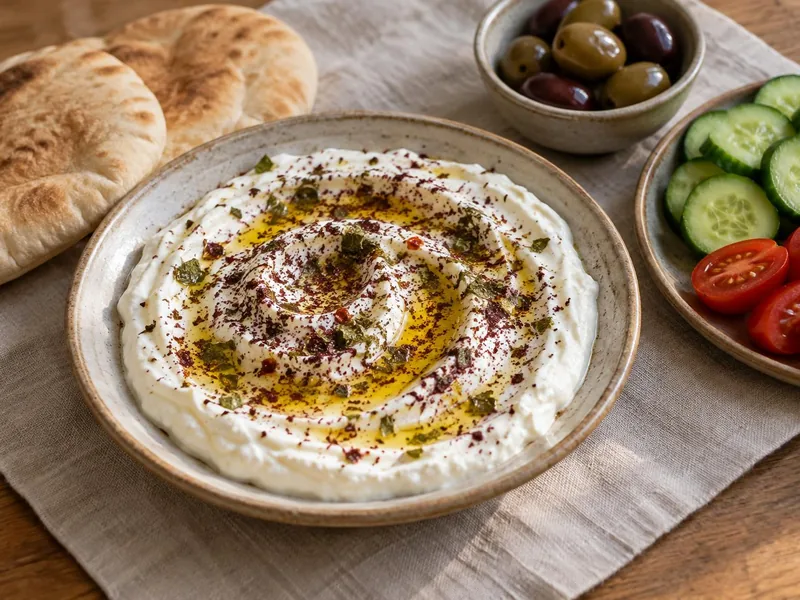 AI-generated image
Labneh
Thick, tangy strained yogurt that needs only two ingredients and a night in the refrigerator.
 AI-generated image
Gözleme with Spinach and Feta
Paper-thin yogurt dough wrapped around salty feta and herby greens, then cooked in a hot skillet until blistered and crisp at the edges.